







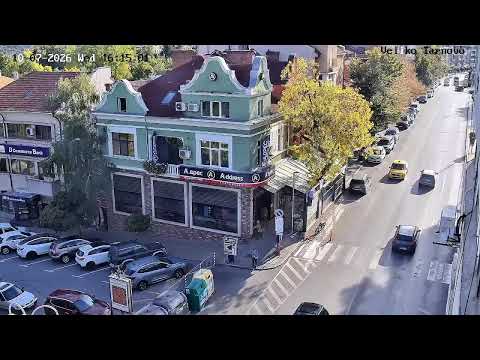


Veliko Tarnovo Center
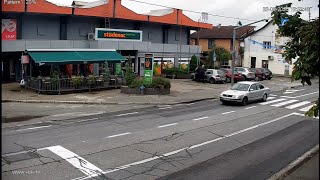
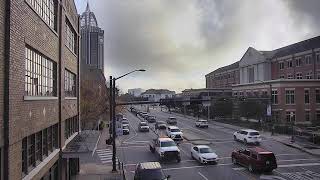
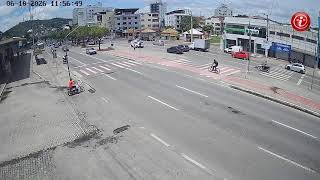
This live webcam shows the center of Veliko Tarnovo, Veliko Tarnovo Province, Bulgaria, overlooking the busy stretch of Vasil Levski Street in the heart of the city. The view captures daily life as pedestrians and vehicles move through one of Veliko Tarnovo’s most recognisable central roads. On the left, the Veliko Tarnovo City Hall stands as a notable civic landmark, while on the right a section of the nearby park can be seen, home to the Monument of Mother Bulgaria, showing the atmosphere of this historic location.
Veliko Tarnovo, Bulgaria
 BG
BG- Tarnovo
- Veliko Turnovo
- Tirnova
Veliko Tarnovo is a historic city in north central Bulgaria and the administrative centre of Veliko Tarnovo Province. Situated on the steep banks of the Yantra River, it serves as the historical and spiritual capital of the nation. The city occupies a strategic position on main roads connecting the West Balkans with the Black Sea and East Europe with the Middle East. Its location amidst the meanders of the river and the foothills of the Balkan Mountains has defined its geographical character for millennia.
With a history spanning more than five millennia, Veliko Tarnovo was a stronghold of the First Bulgarian Empire before becoming the capital of the Second Bulgarian Empire in 1185. The city grew to become the strongest fortification and most prosperous centre during the High and Late Middle Ages. In 1965, the prefix Veliko meaning Great was added to distinguish it from Malko Tarnovo. It remained a centre of resistance until the Ottoman capture in 1393, after which it retained cultural significance through subsequent uprisings.
The old town is built on three hills: Tsarevets, Trapezitsa, and Sveta Gora, rising amidst the river's meanders. Tsarevets housed the palaces of Bulgarian emperors, the Patriarchate, and thick walls, while Trapezitsa was the former residence of the nobility with many churches. The city is known for its unique medieval architecture and the Tarnovo Artistic School. Today, partially restored ruins like the Tsarevets Fortress remain the main sight, alongside the New Town which spills into flatter regions to the west.
As a university city, Veliko Tarnovo features a vivacious nightlife propelled by students from one of Bulgaria's largest universities. It is rich in museums and historical sites that reflect its role as a quasi-cosmopolitan medieval centre with Armenian, Jewish, and Roman Catholic merchant quarters. The city attracts tourists with its picturesque cityscape and heritage status. It continues to be an important cultural and educational hub for Northern Bulgaria, preserving traditions from the Second Bulgarian Kingdom.
The city has a population of 60,067 as of 2025. It experiences a humid continental climate with warm summers averaging 30 °C and cold, snowy winters with averages around −7 °C. Access is available via rail on Line 4 connecting Ruse to Stara Zagora, or by coach from Sofia and Varna. The local area features diverse flora including deciduous forests and fauna such as deer and wild boar, set against a backdrop of chernozem soils and limestone caves.
 The EARF Engine