







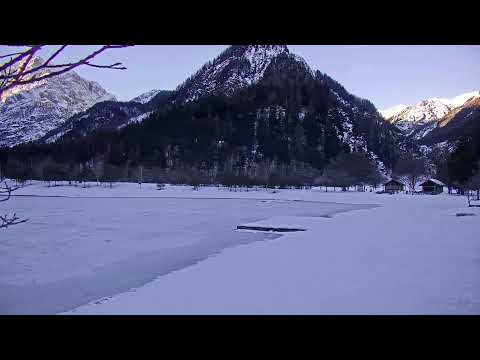


Kranjska Gora, Slovenia
 SI
SI- Borovska Ves
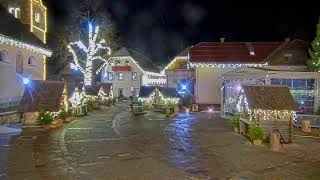
Kranjska Gora is a town situated in northwestern Slovenia within the Upper Carniola region. It lies on the banks of the Sava Dolinka River, positioned close to the borders of both Austria and Italy. The settlement serves as the administrative seat of the Municipality of Kranjska Gora. Its geographic location places it near the tripoint between Austria, Italy, and Slovenia, which is located on the mountain of Dreiländereck, known locally in Slovene as Peč.
The area is believed to have been settled in the 11th century by Slovenes originating from Carantania. It later became a fief of the Counts of Ortenburg during the 12th century, with trade routes to Tarvisio established by the 14th century. The town faced Ottoman attacks in 1476 and saw the construction of a railroad connection in 1870. During the First World War, Russian prisoners of war built a wooden chapel above the settlement in 1916 to commemorate comrades killed in an avalanche while constructing a road over the Vršič Pass.
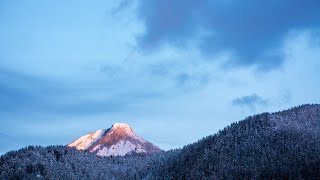
The town is best characterized as a winter sports destination situated in the Julian Alps. It hosts annual events in the FIS Alpine Ski World Cup series, specifically for slalom and giant slalom, known collectively as the Vitranc Cup. The nearby Planica ski jumping hill is located in the Tamar Valley. Historically, the settlement was also referred to as Borovska vas or Borovska ves in Slovene, reflecting its linguistic evolution from earlier German names like Kronau.
Tourism developed significantly after the Second World War, with various ski lifts constructed on Mount Vitranc west of the town between 1949 and 1965. A freight cableway was installed in 1958 to support this growth. The area features a mass grave from the end of the Second World War in its eastern part, containing the remains of up to 35 German soldiers killed in engagements with Partisans in May 1945. This site is also known as the Rušar Meadow Mass Grave.
The population of Kranjska Gora was recorded as 1,519 as of 2020. The local economy is heavily influenced by tourism and winter sports infrastructure. Access to the town is facilitated by regular buses from Ljubljana and Jesenice, with Jesenice providing the nearest railway station. Two daily buses also connect the town to Bled, while car travelers can cross nearby borders into Austria or Italy. Summer bus connections are available from Bovec via the Vršič pass.
 The EARF Engine