International Space Station
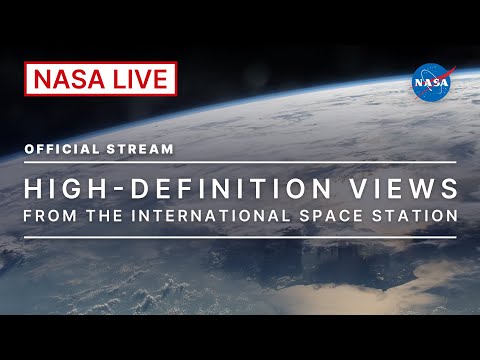
This live stream is brought to you directly by NASA. Watch the ISS orbit Earth from about 250 miles (425 km) above, with a forward-facing view capturing International Docking Adapter 2. If the Harmony module camera is unavailable, a continuous loop of "Previously Recorded" Earth views will play. Operated by an international partnership of five space agencies from 15 countries and continuously occupied since November 2000, the ISS serves as a unique microgravity laboratory for innovative science and research breakthroughs.
Space
- physical space
- Space (philosophy)
- Space (physics)
Space is defined as a three-dimensional continuum containing positions and directions, serving as the fundamental setting for the physical universe. In classical physics, it is often conceived in three linear dimensions, while modern physicists typically consider it part of a boundless four-dimensional continuum known as spacetime alongside time. This concept is regarded as essential to understanding the physical universe, though its nature remains a subject of debate among philosophers regarding whether it is an entity, a relationship between entities, or part of a conceptual framework.
Debates concerning the essence and mode of existence of space date back to antiquity, appearing in works such as Plato's Timaeus and Aristotle's Physics. The 17th century saw significant developments with Isaac Newton viewing space as absolute and independent of matter, while Gottfried Leibniz argued it was merely a collection of relations between objects. Later, Immanuel Kant proposed that space is a subjective form of intuition inherent to the human mind, rather than an empirical concept derived from external experience.
The character of space has been shaped by the evolution of geometric theories, particularly the shift from Euclidean to non-Euclidean geometries in the 19th and 20th centuries. Albert Einstein's theory of general relativity established that space around gravitational fields deviates from flat Euclidean space, a fact confirmed by experimental tests. René Descartes defined Cartesian space as infinite, uniform, and flat, containing matter, while Galileo revised earlier ideas to support heliocentric models where celestial bodies naturally move in circles.
Visitor appeal to the concept of space includes the dream of space tourism, allowing individuals to float in orbit or free fall near Earth. The boundary of outer space is commonly defined as beginning 100 km above sea level at the Kármán line, requiring space technology for survival due to the near-vacuum conditions. While commercial access is currently limited, the region offers unique vantage points and experiences of weightlessness, with low Earth orbit being a popular destination for space stations due to its relative accessibility.
Practical profiles of space involve precise management and mapping, with trajectories computed to the split-second and coordination with mission control occurring in real-time. Travel within this domain requires high speeds, such as 7.8 km/s in low Earth orbit, to maintain position against gravity. The distinction between space and the upper atmosphere is technically arbitrary, but the 100-km altitude serves as a hard limit for air travel, marking the transition where drag becomes negligible and the environment is characterized by extreme emptiness.
 The EARF Engine