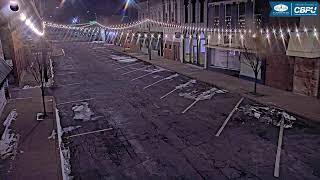









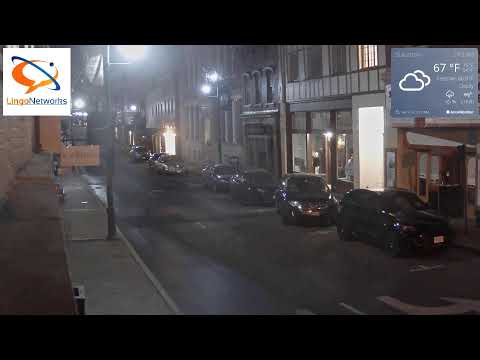


Market Street & East Beverley Street
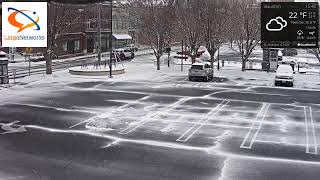
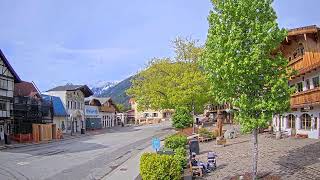
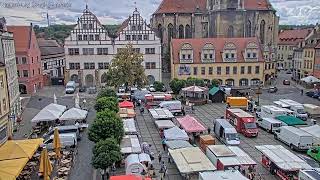
This live camera view captures the intersection of Market Street and East Beverley Street in downtown Staunton, Virginia, USA. The feed shows a stretch of historic commercial buildings fronting the streetscape—brick facades, display windows, and awnings belong to local shops and cafés, set in a preserved 19th- and early-20th-century architectural context.
Staunton, Virginia, United States
 US
US- Staunton, Virginia
- Staunton, VA
- City of Staunton, Virginia
Staunton is an independent city located in the Shenandoah Valley of Virginia, United States. Situated between the Blue Ridge and Allegheny Mountains, it serves as a principal city within the Staunton-Stuarts Draft Metropolitan Statistical Area. As an independent jurisdiction, its government operates separately from the surrounding Augusta County, whose offices are located in contiguous Verona. The city lies at the geographical center of the former colony, a position that historically defined its administrative and regional importance.
The area was first settled in 1732 by John Lewis and family. In 1747, the town was founded and renamed in honor of Lady Rebecca Staunton, wife to Royal Lieutenant-Governor Sir William Gooch. It served as a regional capital for much of the Northwest Territory between 1738 and 1771. During the American Revolution, it hosted Virginia's state legislature in June 1781 when leaders fled Richmond. The city later became an independent city on July 10, 1902, adopting a city manager system that year.
Staunton is known as the birthplace of Woodrow Wilson, the 28th U.S. president. It is home to Mary Baldwin University, historically a women's college, and Stuart Hall, a private co-ed preparatory school. The Virginia School for the Deaf and Blind is also located here. The site of the former Western State Hospital, which operated from 1828, now houses The Villages at Staunton condominiums. The city adopted Lady Rebecca Staunton's coat of arms as its official symbol in 1926.
The city played a crucial role in the mid-18th century expansion of colonial economies through trade and transportation. During the Civil War, it served as a Confederate staging area and supply depot before Union troops destroyed infrastructure in 1864. Today, it retains its historic character with sites like the Staunton Military Academy, founded in 1860. The city's heritage is preserved through its architectural details and historical institutions that reflect its evolution from a remote trading center to a modern independent municipality.
As of the 2020 census, the population was 25,750. The city has a humid subtropical climate, abbreviated as Cfa on climate maps. It covers a total area of 20 square miles, virtually all land, drained by Lewis Creek which flows into the Shenandoah River. The metropolitan statistical area had a 2020 population of 125,433. Transportation developed significantly after the Virginia Central Railroad arrived in 1854, establishing Staunton as a trade and industrial center for the region.
 The EARF Engine