










South America
Argentina
Argentine Republic
"Beats to your rhythm"
Overview
Argentina, officially the Argentine Republic, is a vast federal republic located in the southern cone of South America. Covering an area of 2,780,400 km², it is the fourth-largest country in the Americas and the eighth-largest globally. The nation's geography is highly diverse, ranging from the temperate Pampas grasslands in the east to the arid Patagonian steppes and the Andean mountain ranges in the west. The country is bordered by Chile, Bolivia, Paraguay, Brazil, and Uruguay, and possesses a long coastline on the South Atlantic Ocean. Its capital and largest city is Buenos Aires, a major cultural and economic hub.
Travel Advisory
Government & Politics
| Government Type | Federal Presidential Republic |
|---|---|
| System | Federal Republic |
| President | Javier Milei |
| President | Javier Milei |
| Legislature (Bicameral) | Congress (composed of the Chamber of Deputies and the Senate) |
| Independence | 1816-05-25 from Spanish Empire |
| Constitution | 1853 |
Argentina is a federal republic composed of 23 provinces and the autonomous city of Buenos Aires. Its political system is characterized by a strong presidential mandate and a bicameral legislature. The country has a history of democratic cycles interspersed with periods of military intervention, leading to a complex and often polarized political landscape.
Argentina maintains strong trade and diplomatic ties with its neighbors in Mercosur, particularly Brazil and Uruguay. It also has significant economic relationships with China and the United States. Geopolitically, the country is a key player in the South American bloc, balancing regional cooperation with its national interests.
People, Language & Religion
| Official Languages | Spanish |
|---|---|
| Regional Languages | Guaraní |
| Native Name GRN | Argentina |
| Native Name SPA | Argentina |
| Demonym (Male) | Argentine |
| Ethnic — Mixed | Mixed ancestry |
| Ethnic — European | High percentage (Italian, Spanish, German descent) |
| Ethnic — Indigenous | Significant populations (e.g., Mapuche, Qom) |
| Religion — Judaism | Historically significant community |
| Religion — Catholicism | Majority |
| Religion — Protestantism | Significant minority |
Economy
| GDP (Nominal) | $683.1B USD |
|---|---|
| GDP (PPP) | $1494.1B USD |
| GDP per Capita | $14,898 USD |
| GDP per Capita (PPP) | $32,587 USD |
| GDP Growth Rate | -1.9% |
| Gini Coefficient | 0.424 |
| Human Development Index 0.81 · High | |
| Unemployment Rate | 7.1% |
| Inflation Rate | 219.9% |
| Public Debt (% GDP) | 60% |
| Main Industries | Agriculture (Agribusiness), Services (Finance, Tourism), Manufacturing (Automotive, Food Processing) |
| Main Exports | Soybean products, Corn, Motor vehicles, Meat |
| Main Imports | Machinery and equipment, Petroleum products, Chemicals, Electronics |
| Export Partners | China, Brazil, United States |
| Import Partners | China, United States, Brazil |
| Currency | Argentine peso ($) [ARS] |
Demographics
| Population | 45,851,378 |
|---|---|
| Urban Population | 92.4% |
| Median Age | 34 years |
| Life Expectancy | 77.5 years |
| Fertility Rate | 1.5 |
| Infant Mortality | 8 per 1,000 births |
| Literacy Rate | 99% |
Geography & Climate
Argentina is characterized by extreme geographical diversity. To the west, the Andes Mountains form a massive natural barrier, containing high-altitude plateaus. East of the Andes lies the fertile Pampas plain, one of the world's most productive agricultural regions. Further south, the vast, windswept Patagonian steppe dominates, while the eastern edge is defined by the Atlantic Ocean.
| Terrain | Pampas grasslands, Andean mountains, Patagonian steppes |
|---|---|
| Total Area | 2,780,400 km² |
| Coastline | 2,500 km |
| Exclusive Economic Zone | 1,200,000 km² |
| Landlocked | No |
| Highest Point | Aconcagua (6,961 m) |
| Lowest Point | Atlantic Ocean (0 m) |
| Major Rivers | Paraná River, Uruguay River, Salado River |
| Major Lakes | Nahuel Huapi Lake |
| Major Cities | Buenos Aires, Córdoba, Rosario, Mendoza |
| Natural Resources | Oil and Gas (Vaca Muerta), Agricultural Products (Soy, Wheat), Minerals (Copper, Lithium), Water |
| Climate | Temperate to Arid |
The climate varies dramatically across the country. The Pampas region features a temperate climate with distinct seasons, ideal for agriculture. In contrast, Patagonia experiences a cold, semi-arid steppe climate, while the Andean regions feature alpine and subpolar climates.
History
Ancient & Early History
The region was inhabited by various indigenous groups, including the Tehuelche and Mapuche, who developed complex societies adapted to the diverse environments. Archaeological evidence points to sophisticated hunter-gatherer cultures predating European contact by millennia.
Colonial Period
The area was claimed by the Spanish Empire, forming part of the Viceroyalty of the Río de la Plata. The region was settled by Spanish colonists and later became a key center for cattle ranching and agricultural development under the Viceroyalty.
Independence
The movement for independence gained momentum in the early 19th century, culminating in the declaration of independence from Spain on May 25, 1816. This marked the beginning of the struggle to establish a sovereign nation-state.
Modern Era
Following periods of civil conflict and instability, Argentina established itself as a major economic power in the late 19th and early 20th centuries, fueled by massive European immigration and agricultural exports. Buenos Aires grew into a cosmopolitan metropolis, attracting global attention.
Recent History
The 20th century saw periods of military rule and political turmoil, culminating in the return to democratic rule in 1983. Recent decades have been marked by significant economic volatility, high inflation, and ongoing political debates regarding economic models and social policy.
Culture & National Symbols
Argentine culture is deeply influenced by its European immigrant history, particularly Italian and Spanish traditions. Buenos Aires is renowned for its vibrant tango scene, its grand European-style architecture, and its rich literary heritage. The passion for football (soccer) is a defining cultural element.
| National Anthem | Himno Nacional Argentino — "¡Salve, Mayros! Patria, de preclara historia!" |
|---|---|
| National Animal | Gaucho (Cultural) |
| National Bird | Andean Condor |
| National Flower | Bougainvillea |
| National Tree | Quebracho |
| National Sport | Football (Soccer) |
| National Dish | Asado (Barbecue) |
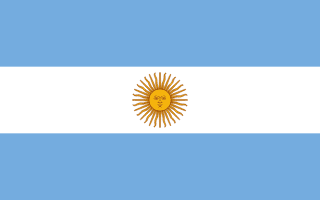
| National Colours | Light Blue, White |
Cuisine
- Asado (Grilled beef cuts)
- Empanadas (Savory baked or steamed pastries)
- Dulce de Leche (Sweetened condensed milk spread)
- Milanesas (Breaded and fried meat cutlets)
Tourism Highlights
- Iguazú Falls (One of the world's largest waterfalls)
- Buenos Aires (Cultural and architectural tours)
- Patagonia (Trekking and wildlife viewing)
- Ushuaia (The 'End of the World' destination)
Natural Wonders
- Iguazú Falls
- Los Glaciares National Park
- Aconcagua Volcano
Notable People
Eva Perón, Jorge Luis Borges, Lionel Messi, Julio Cortázar
Fun Facts
- Argentina is the birthplace of the tango.
- The country claims sovereignty over the Falkland Islands (Malvinas).
Military
| Branches | Army, Navy, Air Force |
|---|---|
| Personnel (Approx.) | 103,000 |
International Relations
| UN Member Since | 1946 |
|---|---|
| Organizations | Mercosur |
| UNESCO Sites | 10 — Historic Centre of Buenos Aires, Iguazú Falls |
Infrastructure & Environment
| Driving Side | Right |
|---|---|
| Electrical | 220V, 50 Hz (Type I) |
| Internet Users | 89.7% |
| Mobile Subscriptions | 140.2 per 100 people |
| CO₂ Emissions | 183.3 Mt |
| Renewable Energy | 9.2% |
Environmental Issues
- Desertification in Patagonia
- Water management in the Pampas
- Deforestation in certain agricultural zones
Communications
| International Calling Code | +54 |
|---|---|
| Internet TLD | .ar |
| Postal Code Format | @####@@@ |
Emergency Services
External Links


 The EARF Engine