






Europe
Croatia
Republic of Croatia
"Full of life"
Overview
Croatia, officially the Republic of Croatia, is a country situated in the region of Central and Southeast Europe, characterized by its extensive coastline along the Adriatic Sea. It shares land borders with Slovenia to the northwest, Hungary to the northeast, Serbia to the east, and Bosnia and Herzegovina and Montenegro to the southeast, while maintaining a maritime border with Italy to the west. The country's geography is highly diverse, encompassing rugged Dinaric Alps, fertile coastal plains, and numerous islands. With a population of approximately 3.87 million people, Croatia's culture is deeply influenced by its Mediterranean location and its history as a crossroads of empires.
Travel Advisory
Government & Politics
| Government Type | Parliamentary Republic |
|---|---|
| System | Unitary Republic |
| President | Zoran Milanović |
| Prime Minister | Andrej Plenković |
| Legislature (Bicameral) | Parliament of the Republic of Croatia |
| Independence | 1991-06-25 from Yugoslavia |
| Constitution | 1990 |
Croatia is a unitary parliamentary republic with a multi-party democratic system. The President serves as the head of state, while the Prime Minister leads the government. The country's political landscape is often defined by the tension between its strong regional identity, its Mediterranean culture, and its integration into broader European political and economic structures.
Croatia maintains strong economic and political ties with the European Union and NATO allies, viewing them as crucial anchors for stability and prosperity. Its foreign policy is heavily influenced by its Mediterranean location, fostering close cultural and trade relationships with Italy, Greece, and the Balkan states.
People, Language & Religion
| Official Languages | Croatian |
|---|---|
| Regional Languages | Italian |
| Native Name HRV | Hrvatska |
| Demonym (Male) | Croatian |
| Ethnic — Serb | Approx. 10% |
| Ethnic — Others | Remaining% |
| Ethnic — Italian | Approx. 8% |
| Ethnic — Croatian | Approx. 75% |
| Religion — Islam | Minority |
| Religion — Catholicism | Majority |
| Religion — Orthodox Christianity | Significant minority |
Economy
| GDP (Nominal) | $105.1B USD |
|---|---|
| GDP (PPP) | $197.5B USD |
| GDP per Capita | $27,104 USD |
| GDP per Capita (PPP) | $50,946 USD |
| GDP Growth Rate | 3.8% |
| Gini Coefficient | 0.301 |
| Human Development Index 0.805 · High | |
| Unemployment Rate | 5% |
| Inflation Rate | 3.7% |
| Public Debt (% GDP) | 45% |
| Main Industries | Tourism, Shipbuilding, Agribusiness, Manufacturing |
| Main Exports | Vehicles, Machinery, Food products, Chemicals |
| Main Imports | Energy products, Raw materials, Consumer goods |
| Export Partners | Germany, Italy, Austria |
| Import Partners | Germany, Italy, Hungary |
| Currency | Euro (€) [EUR] |
Demographics
| Population | 3,876,200 |
|---|---|
| Urban Population | 57.8% |
| Median Age | 40 years |
| Life Expectancy | 78.9 years |
| Fertility Rate | 1.46 |
| Infant Mortality | 4.1 per 1,000 births |
| Literacy Rate | 99% |
Geography & Climate
The country's geography is highly varied, dominated by the rugged Dinaric Alps which run parallel to the Adriatic coast. The coastal region features dramatic karst landscapes, deep natural harbors, and numerous islands, including the Dalmatian archipelago. Inland areas include fertile river valleys and rolling hills, while the Adriatic Sea provides a crucial economic and cultural lifeline.
| Terrain | Karst limestone, Dinaric Alps, and Adriatic coastal plains |
|---|---|
| Total Area | 56,594 km² |
| Coastline | 1,700 km |
| Exclusive Economic Zone | 170,000 km² |
| Landlocked | No |
| Highest Point | Mount Gunung (1,700 m) |
| Lowest Point | Adriatic Sea (0 m) |
| Major Rivers | Kupa River, Neretva River |
| Major Lakes | Lake Skradinski Buk |
| Major Cities | Zagreb, Split, Rijeka, Osijek |
| Natural Resources | Coastal minerals, Forestry products, Agricultural land |
| Climate | Mediterranean |
Croatia experiences a distinct Mediterranean climate, characterized by hot, dry summers and mild, wet winters. The Adriatic coast benefits from maritime influence, resulting in moderate temperatures and significant rainfall concentrated in the autumn and winter months. Inland areas, particularly those influenced by continental weather patterns, can experience greater temperature variations.
History
Ancient & Early History
The region was settled by various groups, including Illyrians, who formed early tribal polities. Later, the area was heavily influenced by the Roman Empire, which established key infrastructure and urban centers, particularly along the Adriatic coast. Following the decline of Rome, the region saw the rise of various Byzantine and Slavic kingdoms.
Colonial Period
Croatia was a key component of the Venetian Republic's sphere of influence and was later incorporated into the Habsburg Monarchy. The Ottoman Empire exerted significant control over parts of the country for several centuries, leading to a complex cultural and religious tapestry. The 19th century saw periods of nationalist revival and struggle for autonomy.
Independence
Croatia declared its independence on June 25, 1991, following the dissolution of the Socialist Federal Republic of Yugoslavia. This declaration was followed by a period of intense conflict, culminating in the Croatian War of Independence.
Modern Era
The country transitioned from a war-torn state to a modern European republic, joining the European Union in 2013. Its modern history is marked by efforts to stabilize its economy, integrate into Western European structures, and preserve its unique Mediterranean identity.
Recent History
The most recent decades have seen Croatia focusing on tourism development and economic integration with the EU single market. Geopolitically, it balances its Mediterranean cultural ties with its commitment to NATO and EU structures, managing the legacy of the Balkan conflicts.
Culture & National Symbols
Croatian culture is a vibrant blend of Slavic, Italian, and Mediterranean influences. Key cultural elements include the preservation of traditional Dalmatian music, the elaborate stone architecture of coastal cities like Split, and the strong emphasis on gastronomy, particularly seafood and local wines.
| National Anthem | Hrvatski himna — "Hrvatski himna" |
|---|---|
| National Animal | The Croatian Lion |
| National Bird | Seagull |
| National Flower | Grapevine |
| National Tree | Oak |
| National Sport | Handball |
| National Dish | Peka |
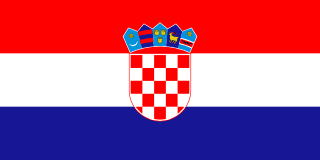
| National Colours | Red, White, Blue |
Cuisine
- Peka (meat and vegetables cooked under a bell)
- Pašticada (beef stew)
- Fresh Adriatic seafood and grilled fish
Tourism Highlights
- The Dalmatian Coast (islands and cities)
- Plitvice Lakes National Park
- Dubrovnik Old Town (UNESCO site)
Natural Wonders
- Plitvice Lakes National Park
- Krka National Park
- Adriatic Sea coastline
Notable People
Ivo Andrić, Ante Pavelić, Stjepan Radić
Fun Facts
- Croatia is famous for its UNESCO World Heritage sites, particularly its medieval coastal towns.
- The country's cuisine is heavily influenced by its maritime location, making seafood a staple.
Military
| Branches | Croatian Army, Croatian Navy, Croatian Air Force |
|---|---|
| Personnel (Approx.) | 20,000 |
International Relations
| UN Member Since | 1992 |
|---|---|
| Organizations | EU, NATO |
| UNESCO Sites | 10 — Plitvice Lakes National Park, Stari Most (Mostar) |
Infrastructure & Environment
| Driving Side | Left |
|---|---|
| Electrical | 230V, 50 Hz (Type F (Schuko), Type L) |
| Internet Users | 83.6% |
| Mobile Subscriptions | 121.7 per 100 people |
| CO₂ Emissions | 18.7 Mt |
| Renewable Energy | 34.1% |
Environmental Issues
- Coastal erosion and pollution
- Sustainable tourism management
- Biodiversity protection in karst regions
Communications
| International Calling Code | +385 |
|---|---|
| Internet TLD | .hr |
| Postal Code Format | HR-##### |
Emergency Services
External Links


 The EARF Engine