










Asia
South Korea
Republic of Korea
"Imagine your Korea"
Overview
The Republic of Korea (ROK), commonly known as South Korea, is a highly developed nation situated on the southern half of the Korean Peninsula in East Asia. It is bordered by the Democratic People's Republic of Korea (DPRK) to the north, separated by the heavily fortified Korean Demilitarized Zone (DMZ). To the west, it faces the Yellow Sea, and to the east, the Sea of Japan (East Sea). The country is renowned globally for its rapid economic development, advanced technology, and vibrant culture, with its population of over 51 million concentrated heavily in the Seoul Capital Area. Major urban centers include Seoul, Busan, and Incheon, forming a dense and modern metropolitan corridor.
Travel Advisory
Government & Politics
| Government Type | Unitary Presidential Republic |
|---|---|
| System | Republic |
| President | Lee Jae-myung |
| President | Lee Jae-myung |
| Legislature (Bicameral) | National Assembly |
| Independence | 1948-08-15 from Japan (Post-WWII) |
| Constitution | 1948 |
South Korea operates as a unitary presidential republic with a robust democratic framework. The President serves as both the head of state and head of government, wielding significant executive power. The National Assembly, a bicameral legislature, is responsible for passing laws and overseeing the executive branch. The political landscape is characterized by major parties competing for influence, with a strong emphasis on economic stability and democratic institutions.
South Korea maintains complex and vital relationships with its immediate neighbors, particularly the DPRK, which is defined by military tension. Internationally, it is a key democratic ally to the United States and a major economic partner to Japan and China. The country actively participates in global trade and multilateral organizations, projecting itself as a responsible and technologically advanced global player.
People, Language & Religion
| Official Languages | Korean |
|---|---|
| Native Name KOR | 한국 |
| Demonym (Male) | South Korean |
| Ethnic — Korean | 99% |
| Religion — Other | 75% |
| Religion — Buddhism | 10% |
| Religion — Christianity | 15% |
| Religion — Confucianism | 10% |
Economy
| GDP (Nominal) | $1872.4B USD |
|---|---|
| GDP (PPP) | $3262.6B USD |
| GDP per Capita | $36,227 USD |
| GDP per Capita (PPP) | $63,125 USD |
| GDP Growth Rate | 2.5% |
| Gini Coefficient | 0.329 |
| Human Development Index 0.95 · Very High | |
| Unemployment Rate | 2.7% |
| Inflation Rate | 2.1% |
| Public Debt (% GDP) | 47.8% |
| Main Industries | Electronics Manufacturing, Automotive, Shipbuilding, Semiconductors |
| Main Exports | Semiconductors, Vehicles, Machinery, Chemical Products |
| Main Imports | Crude Oil, Natural Gas, Iron Ore, Petroleum Products |
| Export Partners | China, Japan, United States |
| Import Partners | China, Japan, Saudi Arabia |
| Currency | South Korean won (₩) [KRW] |
Demographics
| Population | 51,684,564 |
|---|---|
| Urban Population | 81.2% |
| Median Age | 40.5 years |
| Life Expectancy | 83.6 years |
| Fertility Rate | 0.75 |
| Infant Mortality | 2.3 per 1,000 births |
| Literacy Rate | 99.9% |
Geography & Climate
The country occupies the southern portion of the Korean Peninsula, featuring a diverse geography that includes mountainous spine running through the interior, fertile coastal plains, and significant maritime boundaries. The topography is characterized by rolling hills and rugged mountains, which are often covered by dense forests. Major coastal areas include the Yellow Sea to the west and the Sea of Japan to the east, providing crucial ports and economic hubs.
| Terrain | Mountainous with fertile coastal plains |
|---|---|
| Total Area | 100,210 km² |
| Coastline | 2 km |
| Exclusive Economic Zone | 220,000 km² |
| Landlocked | No |
| Highest Point | Hallasan (1,950 m) |
| Lowest Point | Coastal areas (0 m) |
| Major Rivers | Han River, Nakdong River |
| Major Lakes | Lake Daecheong |
| Major Cities | Seoul, Busan, Incheon, Daegu |
| Natural Resources | Coal, Petroleum (limited), Iron Ore, Natural Gas |
| Climate | Humid Temperate |
South Korea experiences four distinct seasons, characterized by a humid temperate climate. Summers are hot and humid, often bringing monsoon rains. Autumn is generally mild and beautiful, while winters are cold, dry, and often feature snowfall. The climate varies significantly between the coastal regions and the mountainous interior.
History
Ancient & Early History
The Korean Peninsula was inhabited by various early cultures, including the Neolithic cultures and the Bronze Age kingdoms. Historically, the region was influenced by Chinese dynasties and developed sophisticated early states, such as the Three Kingdoms period (Goguryeo, Baekje, and Silla).
Colonial Period
Following the collapse of the Joseon Dynasty, the peninsula was subjected to Japanese colonial rule from 1910 to 1945. This period saw the systematic suppression of Korean culture and political autonomy, profoundly shaping modern Korean identity and resistance movements.
Independence
After the Japanese surrender in 1945, the peninsula was temporarily divided by Allied forces, leading to the establishment of the Republic of Korea (ROK) in the south and the Democratic People's Republic of Korea (DPRK) in the north. The ROK declared its independence on August 15, 1948.
Modern Era
The ROK underwent a period of intense reconstruction and rapid industrialization, often termed the 'Miracle on the Han River.' By the late 20th century, it transformed from an agrarian society into a global powerhouse in electronics, automotive, and shipbuilding, achieving high levels of economic development and technological prowess.
Recent History
The country has maintained a strong focus on national security due to its proximity to the DPRK. Economically, it continues to be a global leader in high-tech manufacturing, while politically, it navigates complex relationships with its neighbors and major global powers, emphasizing democratic stability and economic growth.
Culture & National Symbols
South Korean culture, often termed 'Hallyu' (Korean Wave), is globally influential, encompassing K-Pop music, K-dramas, and Korean cinema. Traditional arts, such as Hanbok fashion and Pansori opera, coexist with hyper-modern urban life, creating a unique cultural blend. The country is also celebrated for its cuisine, which emphasizes fermented ingredients and rice.
| National Anthem | A Sprightly Arrival (아리랑) — "Arirang, Arirang, Arirang, Arirang" |
|---|---|
| National Animal | Korean Tiger (extinct in the wild) |
| National Bird | Korean Magpie |
| National Flower | Mugunghwa (Rose of Sharon) |
| National Tree | Ginkgo |
| National Sport | Taekwondo |
| National Dish | Bibimbap |
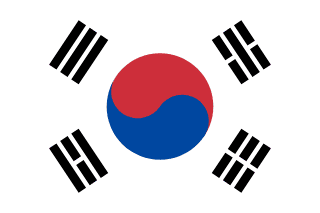
| National Colours | Red, Blue, White |
Cuisine
- Kimchi (fermented cabbage)
- Bibimbap (mixed rice dish)
- Korean BBQ (grilled meats)
Tourism Highlights
- Seoul's modern districts (Gangnam, Myeongdong)
- Busan's coastal attractions
- Jeju Island's natural beauty
- Gyeongju's historical sites
Natural Wonders
- Jeju Volcanic Island
- Hallasan Mountain
Notable People
BTS (K-Pop), Lee Min-ho, Kim Jung-hyun
Fun Facts
- South Korea has one of the world's fastest and most advanced internet infrastructures.
- The country is a global leader in semiconductor and display technology.
Military
| Branches | Army, Navy, Air Force |
|---|---|
| Personnel (Approx.) | 569,000 |
International Relations
| UN Member Since | 1991 |
|---|---|
| Organizations | OECD, G20 |
| UNESCO Sites | 1 — Historic Villages of the Republic of Korea |
Infrastructure & Environment
| Driving Side | Left |
|---|---|
| Electrical | 220V, 60 Hz (Type F (Schuko), Type C) |
| Internet Users | 97.9% |
| Mobile Subscriptions | 172.5 per 100 people |
| CO₂ Emissions | 588 Mt |
| Renewable Energy | 3.6% |
Environmental Issues
- Air pollution (especially in major cities)
- Waste management and plastic pollution
Communications
| International Calling Code | +82 |
|---|---|
| Internet TLD | .kr, .한국 |
| Postal Code Format | SEOUL ###-### |
Emergency Services
External Links



 The EARF Engine