







South America
Uruguay
Oriental Republic of Uruguay
"Libertad o Muerte (Liberty or Death)"
Overview
Uruguay, officially the Oriental Republic of Uruguay, is a country located in the Southern Cone of South America. It is bordered by Argentina to the west and southwest, and Brazil to the north and northeast. To the south, it shares a border with the Río de la Plata estuary and the Atlantic Ocean to the southeast. The nation is known for its stable political history, high quality of life, and strong emphasis on social welfare. Its capital and largest city, Montevideo, serves as the primary economic and cultural hub.
Travel Advisory
Government & Politics
| Government Type | Federal Presidential Republic |
|---|---|
| System | Republic |
| President | Yamandú Orsi |
| President | Yamandú Orsi |
| Legislature (Bicameral) | National Council of Government (Consejo Nacional de Gobierno) |
| Independence | 1825-09-25 from Spanish Empire (via Argentine/Brazilian influence) |
| Constitution | 1967 |
Uruguay is characterized by a stable, multi-party democratic system. Its political landscape is generally moderate, emphasizing social democracy and economic stability. The country has a strong tradition of civil society engagement and a commitment to constitutional rule, making it one of the most stable democracies in the region.
Uruguay maintains close economic and cultural ties with its neighbors, Argentina and Brazil, forming key components of the Mercosur trade bloc. Internationally, it is viewed as a reliable partner committed to multilateralism and democratic principles, often advocating for regional stability and human rights.
People, Language & Religion
| Official Languages | Spanish |
|---|---|
| Native Name SPA | Uruguay |
| Demonym (Male) | Uruguayan |
| Ethnic — Mestizo | Majority |
| Ethnic — Indigenous | Minority |
| Ethnic — European Descent | Significant |
| Religion — Judaism | Notable Minority |
| Religion — Catholicism | Majority |
| Religion — Protestantism | Significant |
Economy
| GDP (Nominal) | $85.3B USD |
|---|---|
| GDP (PPP) | $129.7B USD |
| GDP per Capita | $25,216 USD |
| GDP per Capita (PPP) | $38,315 USD |
| GDP Growth Rate | 4.5% |
| Gini Coefficient | 0.4 |
| Human Development Index 0.83 · Very High | |
| Unemployment Rate | 7.5% |
| Inflation Rate | 4.7% |
| Public Debt (% GDP) | 65.3% |
| Main Industries | Agriculture (beef, dairy), Services (finance, tourism), Textiles |
| Main Exports | Beef, Dairy products, Processed goods |
| Main Imports | Machinery, Fuel, Chemicals |
| Export Partners | Brazil, Argentina |
| Import Partners | Brazil, Argentina |
| Currency | Uruguayan peso ($) [UYU] |
Demographics
| Population | 3,384,688 |
|---|---|
| Urban Population | 95.7% |
| Median Age | 33 years |
| Life Expectancy | 78.3 years |
| Fertility Rate | 1.4 |
| Infant Mortality | 6.2 per 1,000 births |
| Literacy Rate | 98.9% |
Geography & Climate
Located in the Southern Cone of South America, Uruguay is a relatively small, flat country known for its fertile pampas grasslands. It is bordered by Argentina and Brazil, and its southern edge is defined by the Río de la Plata estuary and the Atlantic Ocean. The geography is characterized by rolling plains and low elevation, making it highly suitable for grazing and agriculture.
| Terrain | Low-lying plains (Pampas) with rolling hills |
|---|---|
| Total Area | 181,034 km² |
| Coastline | 350 km |
| Exclusive Economic Zone | 181,034 km² |
| Landlocked | No |
| Highest Point | Cerro Colorado (140 m) |
| Lowest Point | Río de la Plata (0 m) |
| Major Rivers | Río de la Plata |
| Major Lakes | Lago Negro |
| Major Cities | Montevideo, Salto |
| Natural Resources | Fertile agricultural land, Livestock grazing land, Mineral deposits (limited) |
| Climate | Humid Subtropical |
Uruguay experiences a temperate climate, classified as humid subtropical (Cfa). The climate is characterized by hot, humid summers and mild winters. Rainfall is relatively consistent throughout the year, though seasonal variations exist, supporting diverse agricultural practices.
History
Ancient & Early History
The region was historically inhabited by indigenous groups, most notably the Guaraní people, who maintained a semi-nomadic lifestyle along the river systems.
Colonial Period
Uruguay was a contested territory during the colonial era, primarily falling under the influence of the Spanish Empire. Its strategic location led to conflicts between Spanish, Portuguese, and later, British interests.
Independence
The push for independence gained momentum in the early 19th century, culminating in the declaration of independence in 1825, following prolonged conflicts with neighboring powers.
Modern Era
The 20th century saw Uruguay navigate periods of political instability, including military rule. However, the country has maintained a strong commitment to democratic institutions and social progress, establishing itself as a regional leader in human development.
Recent History
In recent decades, Uruguay has focused on economic diversification, promoting itself as a stable, democratic hub in Latin America. It has also become a pioneer in adopting advanced social policies, such as nationwide cannabis legalization.
Culture & National Symbols
Uruguayan culture is a blend of European (especially Italian and Spanish) and indigenous influences. Montevideo is renowned for its vibrant cultural scene, including tango, folklore, and a strong tradition of literary arts. The country places a high value on social life and community.
| National Anthem | Himno Nacional de Uruguay — "¡Oh, patria amada, de campos libres!" |
|---|---|
| National Animal | Jaguar |
| National Bird | Southern Lapwing |
| National Flower | Jacaranda |
| National Sport | Football (Soccer) |
| National Dish | Asado (Barbecue) |
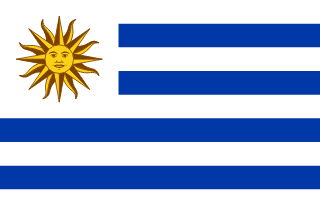
| National Colours | Blue, White |
Cuisine
- Asado (Grilled meats, especially beef)
- Chivito (A popular sandwich)
- Milanesas (Breaded and fried meat)
Tourism Highlights
- Montevideo's historic center and waterfront (Ciudad Vieja)
- The beaches and coastal areas of Punta del Este
- The natural beauty of the Río de la Plata estuary
Natural Wonders
- Pampas Grasslands
- Río de la Plata Estuary
Notable People
José Artigas, Arturo Puig
Fun Facts
- Uruguay is often cited as one of the most stable and least corrupt countries in Latin America.
- It has a high rate of literacy and a strong focus on public health and education.
Military
| Branches | Army, Navy, Air Force |
|---|---|
| Personnel (Approx.) | 22,000 |
International Relations
| UN Member Since | 1948 |
|---|---|
| Organizations | Mercosur |
| UNESCO Sites | 0 |
Infrastructure & Environment
| Driving Side | Right |
|---|---|
| Electrical | 220V, 50 Hz (Type L) |
| Internet Users | 92% |
| Mobile Subscriptions | 145.5 per 100 people |
| CO₂ Emissions | 8.7 Mt |
| Renewable Energy | 57.8% |
Environmental Issues
- Sustainable grazing practices
- Coastal pollution management
Communications
| International Calling Code | +598 |
|---|---|
| Internet TLD | .uy |
| Postal Code Format | ##### |
Emergency Services
External Links


 The EARF Engine