








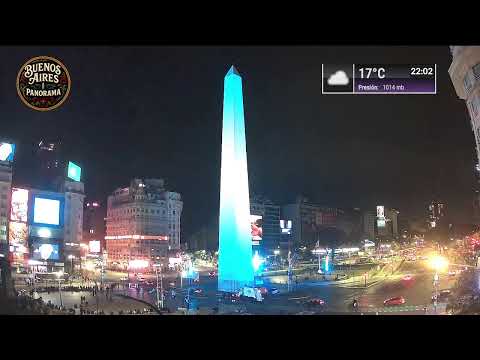


Obelisco
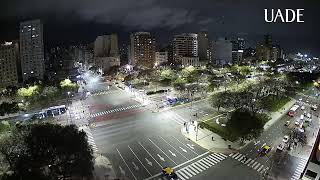
This live stream shows the Obelisco de Buenos Aires in Argentina, located at the intersection of Avenida 9 de Julio and Avenida Corrientes in Plaza de la República, downtown Buenos Aires. The camera captures the 67.5‑meter tall concrete obelisk rising above the wide carriageways of Avenida 9 de Julio, with traffic and pedestrians moving around it, framed by a mix of historic and modern buildings. Built in 1936 by architect Alberto Prebisch to mark the 400th anniversary of the city’s founding, the monument has become an iconic symbol of Buenos Aires, often illuminated at night or serving as a focal point for public gatherings.
Buenos Aires, Argentina
 AR
AR- Ciudad Autonoma de Buenos Aires
- Autonomous City of Buenos Aires
- Capital Federal
Buenos Aires, officially the Autonomous City of Buenos Aires, serves as the capital and largest city of Argentina. It is situated on the southwest bank of the Río de la Plata, functioning as an autonomous district that is neither part of Buenos Aires Province nor its capital. The city holds the distinction of being classified as an Alpha− global city according to the GaWC 2024 ranking and possesses the highest human development index among all Argentine administrative divisions.
The first settlement was established on 2 February 1536 by Pedro de Mendoza, who named it after Our Lady of Bonaria. This initial colony was abandoned in 1541 following attacks by indigenous people. A permanent settlement was founded on 11 June 1580 by Juan de Garay, who preserved the original name. In 1880, following the Argentine Civil War, the city was federalized and split from the province, with its limits later enlarged to include Belgrano and Flores.
The city extends across a plain covering 19.4 km from north to south and 17.9 km from east to west, divided into 48 districts called barrios. It is renowned for its preserved eclectic European architecture and rich cultural life. As a multicultural hub, it is home to multiple ethnic and religious groups, contributing to a unique dialect and making it one of the most diverse cities in the Americas.
Buenos Aires attracts visitors with its beautiful parks, belle epoque architecture, and cosmopolitan nightlife. The city offers a wide choice of cultural events, restaurants, and bars, supported by a receptive attitude towards LGBT culture, including legally recognized same-sex marriages. It is considered one of Latin America's most culturally significant cities, serving as a major point of departure for travel throughout the country.
The city proper has a population of 3,121,707 as of 2022, while its urban area houses 16.7 million people. Buenos Aires enjoys a temperate climate with four distinct seasons, where extreme heat and cold are rare due to its coastal location. Winters are cold with mild daytime temperatures but much colder nights, requiring coats, while the weather generally allows for year-round visitation.
 The EARF Engine