

Codlea, Brașov, Romania
 RO
RO- Feketehalom
- Zeiden
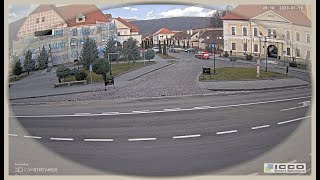
Codlea is a city located in Brașov County within the historic region of Transylvania, Romania. Situated at coordinates 45.6969 north latitude and 25.4439 east longitude, it serves as an important administrative center in this part of the country. The settlement lies near the Măgura Codlei, a prominent geographical feature that influences both the local landscape and the etymology of the area's names.
The origins of Codlea are linked to German settlers who are believed to have founded the city during the medieval period. In the 13th century, the Teutonic Order constructed a fortress known as Schwarzburg near the Măgura Codlei, with the castle's name first recorded in 1265. The structure was last rebuilt in 1432 by local craftsmen's guilds, marking a significant phase in the town's early development and fortification history.
The city is distinguished by its fortified church, which stands as the largest in the Burzenland historic region. The name Codlea may derive from the Latin codella or the Slavic kotlík, referencing the kettle-like shape of the nearby hill. This geographical feature also provided the Hungarian name Feketehalom, meaning Black Hill, while the German name Zeiden is theorized to originate from the word for beekeeper.
Historically, Codlea was renowned for its floral displays and earned the moniker the city of flowers. The community has a diverse cultural heritage reflected in its demographic shifts over centuries. Notable natives include football player Nicolae Florescu, mathematician Alexandru Zaharescu, and volleyball player Doina Popescu, alongside the controversial figure Fritz Klein, a Nazi SS doctor executed for war crimes.
As of 2021, the population of Codlea is 20,534. The climate is classified as warm-summer humid continental under the Köppen system. Previous censuses show a significant decline from a peak of 24,620 in 1992 to 20,534 in 2021, with Romanians comprising the vast majority of inhabitants in recent decades. The city continues to maintain its official presence through local information sites and historical records.
 The EARF Engine