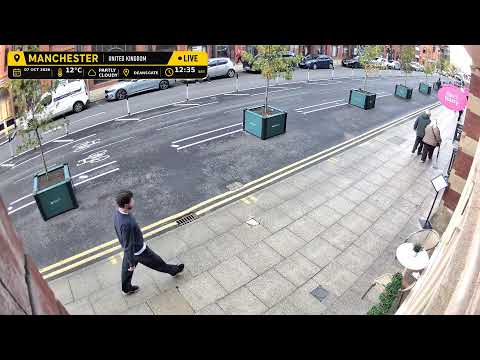


Manchester, England, United Kingdom
 GB
GB- Cottonopolis
- Warehouse City
- Capital of the North
Manchester is a city located in North West England, situated at the centre of the eponymous county of Greater Manchester. It borders the Cheshire Plain to the south, the Pennines to the north and east, and the city of Salford to the west. Together with Salford and surrounding towns, it forms one of the United Kingdom's most populous conurbations, known as the Greater Manchester Built-up Area. The name Manchester originates from Mamucium, the Latin name for the Roman fort established there, while its citizens are referred to as Mancunians.
The city's history began with a civilian settlement associated with the Roman fort of Mamucium or Mancunium, established around AD 79 on a sandstone bluff near the confluence of the rivers Medlock and Irwell. Historically part of Lancashire, it expanded significantly during the Industrial Revolution due to a boom in textile manufacture, becoming the world's first industrialised city. Manchester attained city status in 1853, and its fortune declined after the Second World War before extensive investment followed the 1996 bombing.
The city is notable for its architecture, links to science and engineering, and its role as a host for the 2002 Commonwealth Games. Nicknames originating from its Industrial Revolution role include "warehouse city" and "Cottonopolis," and it is widely known as 'the capital of the North.' The name Manchester officially applies to the metropolitan borough within Greater Manchester, though it is informally applied to various other areas such as the Manchester City Zone and post town.
Manchester is a major centre for culture and commerce, boasting world-famous football clubs, a large student population, and significant musical exports. The city has undergone considerable redevelopment, swapping mills for Michelin stars and warehouses for world-class shopping and museums. It remains proud of its industrial past and influences on music and sport, with the Manchester brand extending well beyond the city's boundaries to influence the wider region.
The city had a population of 547,627 as of 2018, while the Greater Manchester Built-up Area has a population of 2.87 million. The Manchester Ship Canal opened in 1894, linking the city to the Irish Sea 36 miles to the west. It is home to Manchester Airport, one of the UK's best-run international airports and the busiest British airport outside of South East England. The city offers a vibrant atmosphere with unique shopping destinations and urban havens.
 The EARF Engine