









Hawick High Street
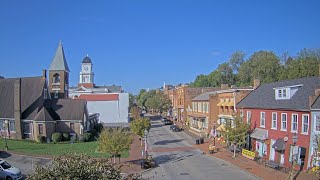
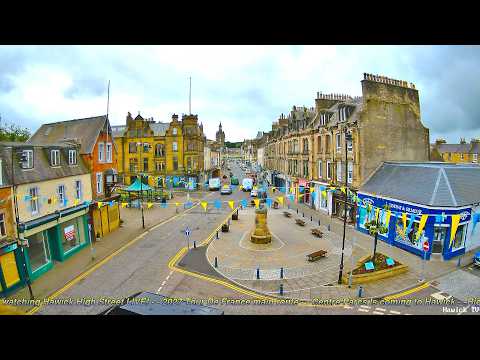
This live stream takes you to Hawick High Street in the Scottish Borders town of Hawick, Roxburghshire. Set along the River Teviot, Hawick is known for its deep-rooted textile heritage, welcoming atmosphere, and scenic charm. At the center of the view is the iconic Horse Statue — a proud symbol of the town’s historic ties to farming and horse trading. you’ll also spot a mix of shops, cafés, and everyday activity that give this High Street its character.
Hawick, Scotland, United Kingdom
 GB
GB- Hawick, Roxburghshire
Hawick is a town situated in the Scottish Borders council area and the historic county of Roxburghshire within the east Southern Uplands of Scotland. Located at the confluence of the Slitrig Water and the River Teviot, it lies in the heart of Teviotdale, making it one of the furthest towns from the sea in Scotland. It serves as the biggest town in Roxburghshire and functions as an important regional centre for shopping, tourism, and services.
The name Hawick derives from Old English, first recorded in 1167, meaning enclosed farm or hamlet. Although formally established in the 16th century with a deed in 1537 declaring it a free burgh, historic settlement dates back hundreds of years. The town grew significantly during the Industrial Revolution and Victorian era as a textile production centre, particularly for knitting and weaving tweed and cashmere.
Hawick features distinctive sandstone buildings with slate roofs and several museums, parks, and heritage sites. Notable landmarks include St Mary's and Old Parish Church, constructed in 1764 on the site of an earlier 13th-century church, and the Motte, remains of a likely 12th-century castle. The town also hosts Hawick Town Hall, built in 1886 in the Scottish baronial style by James Campbell Walker.
The town hosts the annual Common Riding and the Alchemy Film and Moving Image Festival. It is renowned for its rugby heritage, with Bill McLaren being a notable contributor, and was the birthplace of yachtsman Chay Blyth. While textile production declined in the late 20th century, Hawick remains a destination for exploring nearby hills and forests, alongside its historic architecture and cultural events.
Hawick had a population of 13,740 as of 2016, though figures reached 13,512 in 2022. The economy has faced challenges with unemployment exceeding regional averages, yet new developments like a business centre opened in 2024 and a distillery in 2018-19 have provided some relief. Accessible via the A7 road, the town lost its rail service in 1969 but is served by regular buses to nearby stations.
 The EARF Engine