
Northern Lights
Explore Northern Lights & Nature Meditation Cams
85K subscribers
Churchill, Manitoba, Canada

Northern Lights
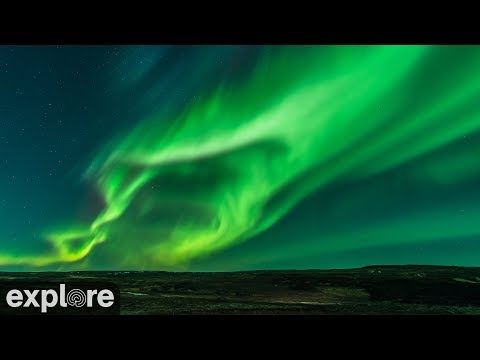
This live stream shows the Northern Lights over Churchill, Manitoba, Canada, captured from the Churchill Northern Studies Centre, a research facility located approximately 14 miles east of the town, along the Hudson Bay coast. The camera offers a real-time view of the aurora borealis, displaying vibrant green, pink, and purple hues as they dance across the subarctic sky. Churchill is renowned as one of the best places on Earth to witness this natural phenomenon, with auroral activity visible on over 300 nights annually, particularly during the darker months of late fall and early spring.
Churchill, Manitoba, Canada
 CA
CAChurchill is a subarctic port town situated in northern Manitoba, Canada, on the west shore of Hudson Bay at the mouth of the Churchill River. Located roughly 140 km from the Manitoba–Nunavut border and far from other major settlements, it lies on the 58th parallel north. The community stands at an ecotone where the boreal forest meets the Arctic tundra and the bay itself, marking a distinct geographical boundary in the Canadian north.
The region was originally inhabited by nomadic Arctic peoples, including the Thule and Dené, before European contact. Europeans first arrived in 1619 when a Danish expedition wintered there, though only three survived. The Hudson's Bay Company established the first permanent settlement, Churchill River Post, in 1717. The area later became home to Prince of Wales Fort, a stone fortification rebuilt in the 1730s and captured by the French in 1782, which is now maintained as a heritage site by Parks Canada.
The town is defined by its proximity to significant historical and natural landmarks. Across the river lies the former site of Prince of Wales Fort and Eskimo Island. The landscape features sparse black spruce cover influenced by permafrost and the Canadian Shield. Nearby attractions include Wapusk National Park to the southeast and the Churchill Northern Studies Centre, which occupies the site of a former rocket research range that operated from 1956 until 1984.
Churchill is renowned for its wildlife tourism, particularly polar bears that move toward the shore in autumn, earning it the nickname Polar Bear Capital of the World. It is also known as the beluga capital of the world. Visitors engage in expeditions using tundra buggies, boats, and helicopters to observe wildlife. The area also offers opportunities to view the aurora borealis during clear nights in February and March, when solar activity is high and skies are dark enough for visibility.
The permanent population was 870 as of 2021. Historically driven by the fur trade and later by grain exports via a rail link from Winnipeg completed in 1929, the economy has shifted toward tourism after the port closed in 2016. The town experiences a harsh subarctic climate with long, frigid winters and short summers. January averages are comparable to much higher latitudes due to prevailing northerly winds across the frozen bay.
 The EARF Engine