

Piazza IV Novembre
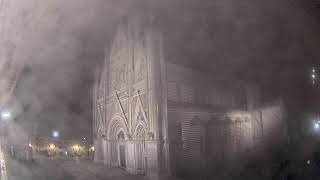
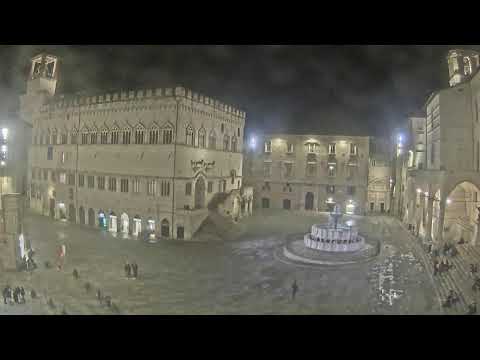
This live camera views Piazza IV Novembre in the historic centre of Perugia, Umbria, Italy. The foreground features the ornate marble and bronze Fontana Maggiore, while beyond it you can see the steps rising to the pink-marble façade of the Cattedrale di San Lorenzo. On the opposite side the Gothic bulk of the Palazzo dei Priori frames the square.
Perugia, Italy
 IT
ITPerugia is the capital city of the Umbria region in central Italy and serves as the administrative center for the province of Perugia. Situated on a high hilltop that extends into surrounding valleys, the urban area is crossed by the River Tiber. Geographically, it lies approximately 164 kilometers north of Rome and 148 kilometers southeast of Florence, establishing its position within the Italian peninsula's central corridor.
The city's history traces back to the Etruscan period, where it functioned as one of the twelve confederate cities of Etruria under the name Perusia. It later played a significant role in Roman history, surviving sieges and eventually becoming a colonia in the third century AD. Throughout the Middle Ages, Perugia maintained an independent communal life, resisting papal sovereignty while hosting five papal conclaves, before eventually accepting a papal legate in the fourteenth century.
Defined by its medieval architecture and artistic heritage, Perugia features landmarks such as the Palazzo dei Priori and the Etruscan Well. The city is renowned for its association with Renaissance artists like Perugino and Pinturicchio, whose works adorn local galleries. Its symbol, the griffin, appears in statues and plaques throughout the historic center, reflecting its Guelph political alignment and enduring civic identity across centuries of rule.
As a major cultural hub, Perugia attracts visitors with its vibrant festival scene, including the annual Umbria Jazz Festival in July and the International Journalism Festival in April. The city is also a significant producer of chocolates and hosts numerous museums accessible via the Perugia City Museum Card. Its status as a university town, home to institutions founded in the fourteenth and sixteenth centuries, adds to its dynamic academic and artistic atmosphere.
Perugia has a population of 161,748 as of 2023, making it the twenty-third-largest city in Italy. Access is facilitated by Perugia Airport, direct train connections from Rome and Florence, and proximity to the A1 autostrada. The city's economy benefits from tourism, education, and confectionery production, while its elevated location offers distinct climatic conditions typical of a central Italian hill town.
 The EARF Engine