

Mamaia Hotel Malibu
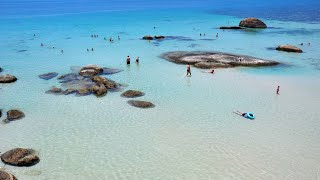
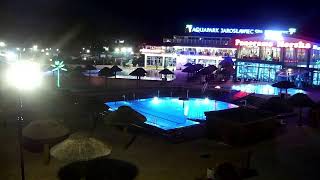
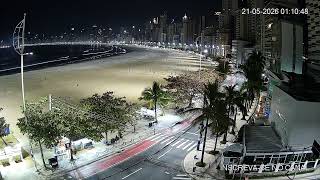
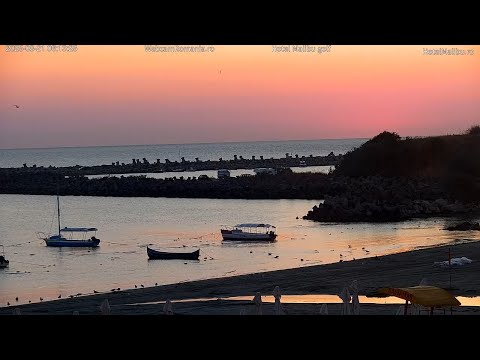
This live webcam streams from Hotel Malibu in Mamaia, Romania’s premier Black Sea resort, offering a real-time view of the beachfront, pool area, and gentle waves rolling ashore. Nestled between the clear waters of the Black Sea and Lake Siutghiol, the hotel enjoys a quieter spot at Mamaia’s southern entrance, away from the usual hustle of the resort center.
Constanța, Romania
 RO
RO- Constantza
- Constanca
- Kustendja
Constanța is a coastal city situated in the Northern Dobruja historical region of Romania, serving as the capital of Constanța County. It stands as the country's fourth largest city and functions as the principal port on the Black Sea coast. The urban area lies within the Southeastern development region, positioned directly along the shoreline with a beach length extending for thirteen kilometres. As an administrative center, it anchors the county and represents a significant hub for maritime activity in the region.
Founded around 600 BC as the Greek colony of Tomis, Constanța is the oldest continuously inhabited city in Romania and among the oldest in Europe. The site was later incorporated into the Roman Empire, where it served as the capital of Scythia Minor. Following the Russo-Turkish War, the city became part of Romania in 1878, transitioning from a small settlement to a major seaport. Its history reflects a rich multicultural heritage, having been influenced by Roman, Byzantine, Bulgarian, and Ottoman cultures over the centuries.
The city features notable landmarks such as the Constanța Casino, an Art Nouveau building commissioned in 1910, and the Grand Mosque, originally named after King Carol I. Ovid's Square honors the Roman poet exiled there by Emperor Augustus, while the Genoese Lighthouse stands as a historic monument. The urban landscape includes the Cathedral of Saints Peter and Paul and the Constanța Aquarium. These sites reflect the city's layered past, from ancient Greek foundations to its modern identity as a cultural destination.
Constanța attracts visitors with its Black Sea beaches and maritime heritage, offering access to the largest port on the Black Sea. The city hosts museums such as the National History and Archaeology Museum, housed in the old City Hall, which displays artifacts from the ancient period of Tomis. The area is known for its multicultural history, with communities of Tatars, Greeks, Turks, and Romani residents contributing to its diverse social fabric. Summer tourism is significant, drawing people to the coastal resorts and historic sites.
As of 2021, the city has a population of 269,700, while the metropolitan area includes fourteen localities within thirty kilometres. The economy is heavily tied to the Port of Constanța, which covers an area of 39.26 square kilometres and serves as a key transit point for exports. Access is provided via the Mihail Kogălniceanu International Airport, railway connections to Bucharest, and extensive bus networks. The climate is humid subtropical, with hot summers and mild winters, making it a year-round destination despite occasional winter storms.
 The EARF Engine