







Crescent Bay
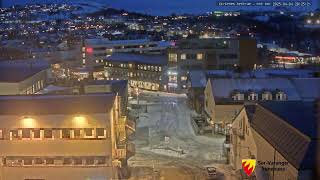
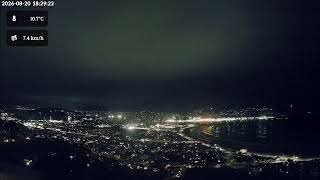
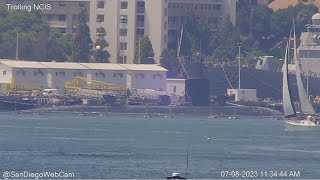
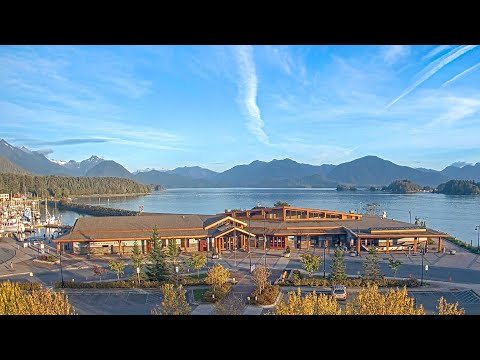
The live webcam shows Crescent Bay in Sitka, Alaska, with the rugged backdrop of Baranof Island’s forested peaks. In view is the Sitka Historical Society & Museum, spotlighting the area’s deep Tlingit, Russian, and American roots. To the left, Crescent Harbor hosts fishing boats and sailboats, while the historic W.P. Mills House appears on the right.
Sitka, Alaska, United States
 US
US- New Archangel
- Sheetʼká
- Novo-Arkhangelsk
Sitka is a unified city-borough located in the southeast portion of the U.S. state of Alaska, situated within the Alexander Archipelago of the Pacific Ocean. It occupies the west side of Baranof Island and the south half of Chichagof Island in the Alaska Panhandle. As a consolidated municipal entity, it serves as a significant administrative center in this remote region, distinguished by its unique geographic position on the outer waters of the Inside Passage.
The area was first settled by Tlingit Aboriginal people before Russian explorers established Old Sitka in 1799 under Alexander Baranov. Following a conflict in 1802 and a subsequent victory in 1804, the Russians founded New Archangel, which became the capital of Russian America until 1867. The transfer of sovereignty to the United States occurred on October 18, 1867, with Sitka serving as the government capital for the Department and District of Alaska until 1906.
The city features historic architecture including the Russian Bishop's House and the original Cathedral of Saint Michael, which was restored after burning in 1966. Japonski Island is connected to Baranof Island by the John O'Connell Bridge and hosts the Sitka Rocky Gutierrez Airport and Mt. Edgecumbe High School. The downtown area is accessible on foot, with landmarks like Castle Hill marking the site of the historic transfer ceremony celebrated annually as Alaska Day.
Sitka attracts approximately a quarter million visitors annually, drawing cruise ship tourists to its ports during the summer months. The community maintains strong cultural ties through institutions like the Alaska Native Brotherhood Hall and the Filipino Community of Sitka. Visitors explore the town via free municipal Wi-Fi and shuttle services from docking facilities, engaging with local history and the natural environment of the Tongass National Forest.
As of the 2020 census, Sitka had a population of 8,458, making it the fifth-most populated city in the state. The economy historically relied on gold mining and fish canning, later supported by the Alaska Pulp Corporation. Accessible only by air or sea, the city experiences an oceanic climate with moderate temperatures and abundant precipitation, averaging 131.74 inches of annual rainfall.
 The EARF Engine