








Union Pacific Rail - Kearney
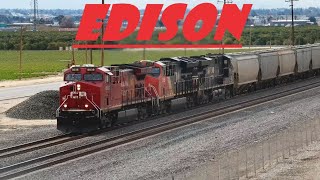
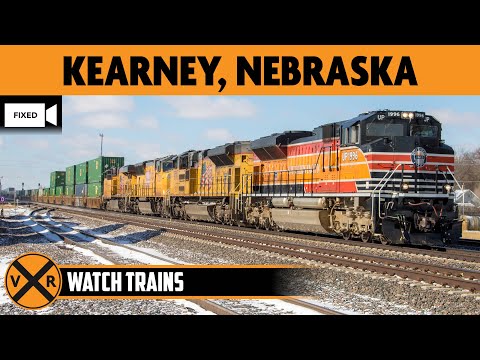
This live stream faces west along the Overland Route in Kearney, Nebraska, a central stretch of the historic First Transcontinental Railroad. Located on the Kearney Subdivision at milepost 188.8, this corridor is one of the busiest freight rail lines in North America. Trains seen here are typically bound for Bailey Yard in North Platte, the world’s largest rail classification yard. Streaming continuously, the camera captures a steady mix of intermodal, manifest, and local freight traffic. With up to around 80 trains passing daily, it delivers constant rail activity, modern locomotive consists, and expansive Midwestern landscapes.
Kearney, Nebraska, United States
 US
US- Kearney, Nebraska
- Kearney, NE
- Kearney, Nebraska micropolitan area
Kearney is a city located in the state of Nebraska within the United States. It serves as the county seat of Buffalo County and sits at the geographic center of a seven-state region encompassing approximately twenty million people. The city is positioned along Interstate 80, providing direct access to major markets such as Omaha-Lincoln, Denver, Kansas City, Des Moines, Wichita, and Cheyenne. Its strategic location on major east-west transportation arteries has historically defined its role as a regional crossroads.
The area's development began in the late 1840s with American settlers traveling westward along the Mormon Trail and Overland Trails. In 1848, the US Army established Fort Kearny southeast of the present city to safeguard migrants, naming it after military officer Stephen W. Kearny. The first permanent settlement, Dobytown, was located two miles southeast of the current site. The city's modern iteration emerged in 1866 with the arrival of the Union Pacific Railroad, and a junction point with the Burlington & Missouri River Railroad in 1871 anticipated the townsite's establishment. Kearney was officially incorporated on December 3, 1873.
During the post-Civil War Gilded Age, Kearney experienced rapid economic expansion fueled by speculative investment from the East. This era saw the construction of an irrigation canal, electric street railway, and a five-story opera house, marking the city as one of the most progressive small cities west of the Missouri River. Although an agricultural depression in the early 1890s halted this boom, the community remained a hub for business and transportation. The name Kearney evolved from a misspelling by postmen who consistently added an 'e' to the original spelling.
Kearney is home to the University of Nebraska at Kearney and several museums reflecting its history on the California, Mormon, Oregon, and Pony Express trails. A notable landmark is the Great Platte River Road Archway Monument, which spans Interstate 80 at mile marker 274 and contains exhibits tracing the history of the Great Platte River Road. The city also holds historical significance in religious administration, having been the center of the Catholic diocese of Kearney from 1912 until its suppression in 1917.
As of the 2020 census, Kearney had a population of 33,790, making it the fifth most populous city in Nebraska. The city is the principal city of the Kearney, Nebraska Micropolitan Statistical Area, which includes Buffalo and Kearney counties. Key employers include Citizens Telecommunications Company of Nebraska and The Buckle. The city covers a total area of 13.00 square miles, with 12.77 square miles of land and 0.23 square miles of water.
 The EARF Engine