









Live stream unavailable
This camera is offline or temporarily unavailable. It may be under maintenance, having technical trouble, or it may have been removed by the provider. Listings are monitored continuously and this page updates when the stream returns.


Grauerort Fortress Courtyard
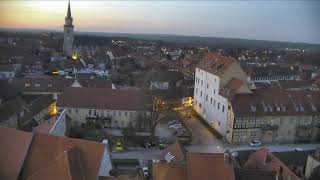
This live stream shows the courtyard of Festung Grauerort near Stade, Lower Saxony, Germany. The 19th-century coastal fortress overlooks the Elbe River and was built for the defense of Hamburg. The view captures the historic inner courtyard and surrounding fort walls.
Stade, Lower Saxony, Germany
 DE
DE- Hanseatic City of Stade
- Stood
Stade is a city located in Lower Saxony in northern Germany, situated within the lower regions of the river Elbe. It serves as the administrative seat of the district that bears its name and lies approximately 45 kilometers to the west of Hamburg, placing it within that city's wider metropolitan region. The municipality encompasses several urban districts, including Bützfleth, Hagen, Haddorf, and Wiepenkathen, each possessing its own council with autonomous decision-making rights. Its position in the Elbe Weser Triangle highlights its strategic location along one of Europe's major waterways.
First mentioned in records in 934, Stade has a long and complex history shaped by various rulers and conflicts. It was granted important town privileges by Emperor Otto IV in 1209 and became a prominent member of the Hanseatic League from the thirteenth to the late seventeenth century. The city experienced Swedish rule for several decades, during which it served as the capital of the province, before passing through Danish and Hanoverian control. Significant events include the Thirty Years' War, where two-thirds of the town were razed in 1659, and subsequent reconstructions that preserved its historic layout.
The Old Town of Stade features notable historic buildings that define its architectural character, including the St. Cosmae et Damiani Lutheran Church and the Wilhadi Lutheran Church, known for its leaning tower. Other key landmarks include the city hall, the Schwedenspeicher, and the Zeughaus. The area also contains the Alter Hansehafen, or Old Hanseatic Harbor. Nearby, the gigantic pylons of Elbe Crossing 1 and Elbe Crossing 2 stand as modern engineering feats, with the latter being the tallest in Europe.
Cultural attractions in Stade include the Schwedenspeicher-Museum, which houses regional cultural history within a former Swedish granary, and the Kunsthaus Stade, an art museum located in a sixteenth-century merchant building. The Freilichtmuseum auf der Insel offers an open-air experience on the site of a seventeenth-century fortification. The city's heritage is further enriched by its historical Jewish community, which established a land-rabbinate in 1845 and built a synagogue that opened in 1849, reflecting the diverse social fabric developed over centuries.
As of 2024, Stade has a population of 48,633 residents. The local economy has benefited significantly from the presence of chemical and aerospace industries along the Elbe river, notably Dow Chemical and Airbus. Transport access is facilitated by the S-Bahn Hamburg line S3, which connects the city to Hamburg central station in roughly one hour. The decommissioned Stade Nuclear Power Plant, closed in 2003, remains a part of the industrial landscape near the river.
 The EARF Engine