

Duhnen Beach
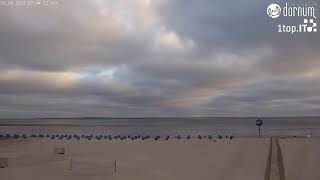
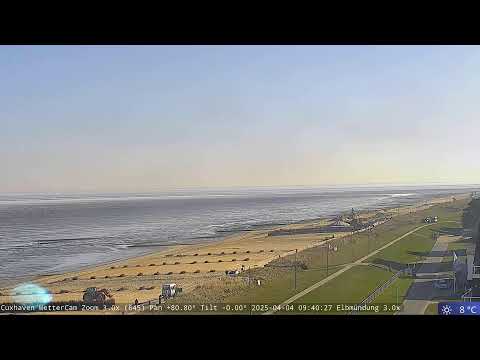
This live camera view from the seaside resort of Duhnen in Cuxhaven, Lower Saxony, Germany, features the long, flat sandy beach of Duhnen stretching along the North Sea coast, with the beach-promenade, typical striped beach-chairs, and the tidal flats of the adjacent Wadden Sea visible. The stream shows the coastline’s changing light, weather and tide conditions in real time — offering a vibrant glimpse of this tranquil yet active coastal destination.
Cuxhaven, Lower Saxony, Germany
 DE
DECuxhaven is a port town and the administrative seat of the Cuxhaven district in Lower Saxony, Germany. Situated on the North Sea shore at the mouth of the Elbe River, it serves as a gateway to the nearby Heligoland islands. The town includes the northernmost point of Lower Saxony and functions as a significant ship registration point for Hamburg until 2008.
The area's history is rooted in Ritzebüttel, which belonged to Hamburg from the 13th century until 1937 when it became part of Prussia via the Greater Hamburg Act. Cuxhaven gained city status within Hamburg in 1907 before its incorporation into Lower Saxony. The town was also a major Imperial German Navy airship station during World War I and hosted Wehrmacht radio networks during World War II.
The city features a footprint of 14 by 7 kilometers, with popular vacation quarters Duhnen, Döse, and Sahlenburg. Key landmarks include the Kugelbake beacon marking the river-sea boundary and Ritzebüttel Castle. The Friedrich-Clemens-Gerke Tower stands as a modern telecommunication structure, while the island of Neuwerk lies eight kilometers off the coast, accessible by mudflat hiking at low tide.
Tourism is a central industry, with Cuxhaven recognized as a state-recognized climate seaside resort since 1964. Visitors are drawn to its fisherman's wharf and the restored Hamburg America Line terminal, now a museum. The Jacobikirche in Lüdingworth is notable for its Arp Schnitger organ. The city also hosts the Joachim Ringelnatz-Museum, honoring the poet and cabaret artiste.
Cuxhaven has a population of 49,443 as of 2025. Its economy relies on fishing, shipping, and tourism, with the Cuxport deep-water port handling significant cargo including offshore wind components. Accessible by train from Hamburg or Bremen, the city experiences an oceanic climate with warm winters and cool summers, recording extremes from -18.2 °C to 36.3 °C.
 The EARF Engine