

Hotel ChiemseePanorama
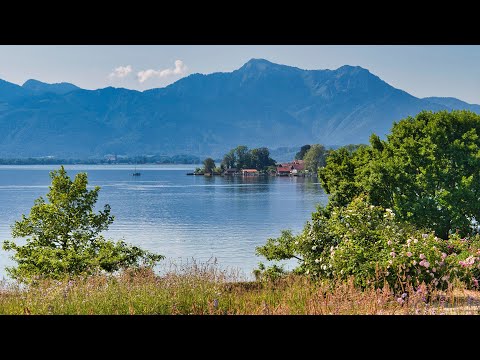
This live webcam stream captures stunning panoramic views from Hotel ChiemseePanorama in Gstadt am Chiemsee, Bavaria. Facing the expansive Chiemsee lake—often called the "Bavarian Sea"—the stream showcases tranquil waters, ferry routes to Herreninsel, and the distant Alpine peaks. It’s a serene window into one of southern Germany’s most scenic lakeside destinations.
Gstadt am Chiemsee, Bavaria, Germany
 DE
DE- Gstadt
Gstadt am Chiemsee is a municipality and village situated in the district of Rosenheim within Bavaria, Germany. It rests on the northern shore of Lake Chiemsee, which holds the distinction of being the largest lake in Bavaria with an area of 84 square kilometers. This body of water is locally referred to as the Bavarian Sea due to its expansive nature. The location serves as a key point for maritime access across the lake, historically functioning as the departure point for boats traveling to the monastery of Frauenchiemsee.
The earliest evidence of human settlement in the region dates back to the Stone and Bronze Age, spanning from 5000 to 500 BC. Archaeological findings include commodities and remains of lake dwellings, which are now displayed at the Bedaium Museum in Seebruck and the Museum in Traunstein. During the Middle Ages, Bavarians from the Elbe river area settled in the region. Gstadt was first documented in 1168 under the original name Gestadte and belonged to the monastery of Frauenchiemsee before becoming an official municipality following the administrative reform of Bavaria in 1818.
The municipality comprises numerous distinct parts including Gollenshausen, Aich, Aiglsbuch, Aisching, Ed, Lienzing, Lienzinger Moos, Loiberting, Mitterndorf, Plötzing, Preinersdorf, Schalchen, Söll, and Weingarten. The area lies within the Chiemgau region, which was formerly a Roman province of Noricum. While the town retains its historical layout, it has evolved from its origins as a loyal agricultural community into a destination that caters to tourism, particularly after World War II, while maintaining its connection to the lake's geography.
In the 19th century, Gstadt became a frequent destination for poets, writers, and painters who arrived by stagecoach from Munich to visit the islands. The town's cultural appeal is supported by nearby museums housing ancient artifacts, offering visitors insight into the area's deep historical roots. The scenic location on the lake continues to attract those seeking natural beauty and artistic inspiration, preserving the legacy of its past as a retreat for creative individuals traveling from major urban centers.
As of 2024, the population of Gstadt am Chiemsee is recorded at 1,157 residents. The local economy has transitioned over centuries from agriculture to tourism, leveraging its position on the north side of the lake. Access to the municipality is facilitated by its role as a transport hub for lake crossings and historical stagecoach routes. The climate supports year-round appeal, with the surrounding landscape providing a distinct Bavarian atmosphere for visitors exploring the Chiemgau region.
 The EARF Engine