








Weser Stadium
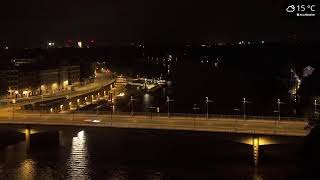
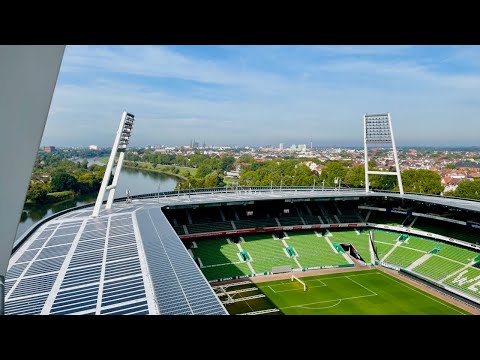
This live webcam shows the Weser Stadium in Bremen, Germany, home of SV Werder Bremen. The camera looks across the banks of the Weser River toward the distinctive green-and-white stadium, with its modern roof structure rising above the surrounding riverside landscape. Boats occasionally pass along the river in the foreground, while nearby paths and greenery frame the stadium setting.
Bremen, Germany
 DE
DE- City Municipality of Bremen
- Hansestadt Bremen
- Hanseatic city of Bremen
Bremen, officially the City Municipality of Bremen, serves as the capital of the Free Hanseatic City of Bremen, a two-city-state in northern Germany. Situated on both sides of the River Weser approximately sixty kilometers upstream from its mouth at Bremerhaven, it is completely surrounded by the state of Lower Saxony. As the largest city on the Weser and the third-largest in the Low German dialect area, it anchors the Northwest Metropolitan Region alongside Oldenburg and Bremerhaven. The municipality is contiguous with several Lower Saxon towns, including Delmenhorst and Stuhr, while maintaining an exclave in Bremerhaven known as the City of Bremen Overseas Port Area.
The city traces its origins to a settlement in the early Middle Ages, becoming the seat of a bishopric in 787. During the High Middle Ages, it evolved into a flourishing trading center and joined the Hanseatic League in the thirteenth century, establishing extensive commercial links across Northern Europe. Bremen retained autonomy as a free imperial city within the Holy Roman Empire until its annexation by France in 1810, after which it regained independence in 1815. It later became a founding state of the Federal Republic of Germany, preserving a strong civic identity despite periods of conflict and foreign rule throughout its twelve-hundred-year history.
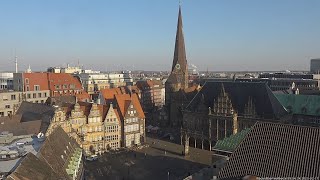
Bremen is defined by its historic architecture and cultural landmarks, most notably the Town Hall and Roland on the Marketplace, which form a UNESCO World Heritage Site. The city features diverse galleries and museums, such as the Bremen Overseas Museum and Weserburg, alongside statues dedicated to the Brothers Grimm fairy tale characters, the Town Musicians of Bremen. Geographically, the inner city lies on a Weser dune with a natural height of 10.5 meters at the cathedral, while the highest natural point reaches 32.5 meters in Friedehorst Park. This topography gives Bremen the lowest high point of all German states.
As a major cultural and economic hub, Bremen attracts visitors with its UNESCO City of Literature designation and vibrant international community. The city hosts numerous festivals and events, reflecting its diverse population which includes significant Turkish, Arab, West African, and South Asian communities. Its dining scene is noted for serving seriously spicy food by default in many eateries. The historic market square and the statue of the Town Musicians remain central tourist draws, symbolizing the city's enduring literary heritage and medieval Hanseatic past.
Bremen has a population of 586,271 as of 2024, with the broader metropolitan region housing around 2.8 million people. Its economy is driven by shipping, overseas trade, and a major port that ranks second in Germany after Hamburg. Access is facilitated by Bremen Airport, Germany's twelfth-busiest, located in the southern borough of Neustadt-Neuenland. The city experiences a moderate oceanic climate with mild temperatures, though winters can be gloomy with minimal sunshine, while summers see average highs between 20.2 and 22.6 degrees Celsius.
 The EARF Engine