








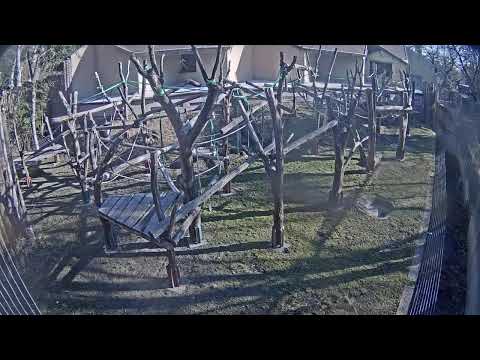


Orangutans in Budapest Zoo
This live stream shows the critically endangered Sumatran orangutans at Budapest Zoo & Botanical Garden, one of the oldest zoos in the world established in 1866. These reddish-brown great apes are native to the rainforests of Sumatra and are the world's largest arboreal mammals, spending most of their time in trees. Orangutans are highly intelligent, using tools to extract food from trees and demonstrating problem-solving abilities.
Budapest, Hungary
 HU
HU- Buda Pest
- Buda and Pest
Budapest serves as the capital and most populous city of Hungary, functioning as the nation's primate city. It stands on the River Danube at the center of the Pannonian Basin, strategically located on ancient trade routes linking Transdanubia with the Great Plain. As the political, economic, and cultural center of the country, it is among the ten largest cities in the European Union and the second largest urban area in Central and Eastern Europe.
The city's history began with an early Celtic settlement later transformed by Romans into Aquincum, the capital of Lower Pannonia. Following the foundation of Hungary in the late 9th century, the area endured Mongol pillaging before becoming a royal seat in 1361. After nearly 150 years of Ottoman rule, the unification of Buda, Pest, and Óbuda in 1873 created modern Budapest, which subsequently became the co-capital of the Austro-Hungarian Empire until its dissolution in 1918.
The historic center along the Danube is a UNESCO World Heritage Site featuring classical architecture from the 13th to 19th centuries. Notable landmarks include Matthias Church, Buda Castle, the Hungarian Parliament, and St. Stephen's Basilica. Administratively divided into 23 districts, the city is colloquially split between the hilly western bank of Buda and the flat eastern bank of Pest, with the Danube islands forming a distinct part of neither.
Renowned as the spa capital of Europe, Budapest boasts over 100 medicinal geothermal springs and the largest thermal water cave system. It hosts more than 40 museums, nearly ten Michelin-starred restaurants, and ruin bars that define its vibrant nightlife. The city is also a major hub for Hollywood film production and regularly hosts global sporting events, including matches at the Puskás Aréna and international athletics championships.
Budapest has a population of 1,685,209 as of 2025, with its greater metro area housing approximately 3.3 million people. The economy produces over 40% of Hungary's output, supported by a global city status and a GDP exceeding US$120 billion. Public transport includes the M1 Millennium Underground, opened in 1896, which forms part of a network moving 2.2 million people daily across the urban landscape.
 The EARF Engine