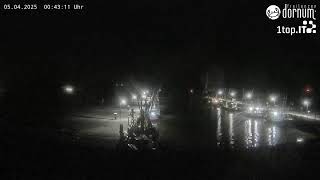











Djúpivogur Harbour
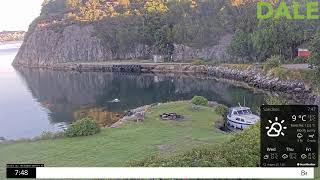
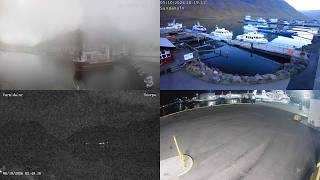
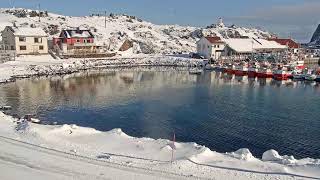
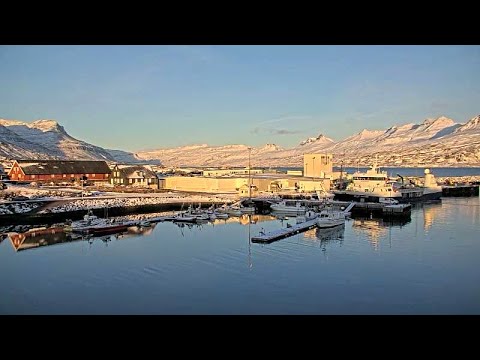
This live stream overlooks Djúpivogur Harbour in East Iceland, a quiet coastal village surrounded by snow-covered mountains and the North Atlantic. The camera captures fishing boats, calm Arctic waters, and the peaceful atmosphere of this remote community.
Djúpivogur, Eastern Region, Iceland
 IS
IS- Djúpavogshreppur
Djúpivogur is a small town situated on a peninsula in the Austurland region of eastern Iceland. It lies near the island of Papey and along the fjord Berufjörður, with its coastline encompassing three distinct fjords: Berufjörður, Hamarsfjörður, and Álftafjörður. The town occupies a specific position on the peninsula between Berufjörður and Hamarsfjörður. Historically, it served as a former municipality known as Djúpavogshreppur before administrative changes occurred in the early twenty-first century.
The area developed from a tiny port with a Danish colonial trading base by the early nineteenth century. Hans Jonatan, formerly a slave in Copenhagen, escaped to this location and became one of Iceland's first people of colour. The municipality of Djúpavogshreppur was formally established on October 1, 1992, through the merger of rural communities Berunes, Buland, and Geithellur. In 2020, it merged with Borgarfjarðarhreppur, Fljótsdalshérað, and Seyðisfjarðarkaupstaður to form the new municipality of Múlaþing.
The town features Langabúð, one of Iceland's oldest commercial buildings, with a south end dating to 1790 and a northern part added in 1850. This structure previously served as a warehouse and slaughterhouse before becoming home to a café, heritage museum, and an exhibition on local sculptor Ríkarður Jónsson. Approximately 900 meters west of the town stands Eggin í Gleðivík, a sculpture by Sigurður Guðmundsson installed in summer 2009 as a replica of eggs from thirty-four nesting birds.
Djúpivogur holds the distinction of being the first and only Cittaslow town in Iceland. This status aligns with the slow movement's goals to improve quality of life by slowing the pace of daily activities, particularly regarding traffic flow and space usage. The town also hosts cultural exhibitions related to its native artists and preserves historical narratives through its heritage museum, offering visitors a glimpse into the region's colonial past and artistic contributions.
The population was recorded as 472 in 2019. The nearby Teigarhorn farm, located five kilometers west, operates one of Iceland's oldest weather stations since 1874 and holds the national record for highest temperature at 30.5 °C in 1939. Djúpivogur experiences a cold tundra climate, characterized by mild winters that closely resemble a subpolar oceanic climate, though no month averages above 10 °C.
 The EARF Engine