Live stream unavailable
This camera is offline or temporarily unavailable. It may be under maintenance, having technical trouble, or it may have been removed by the provider. Listings are monitored continuously and this page updates when the stream returns.

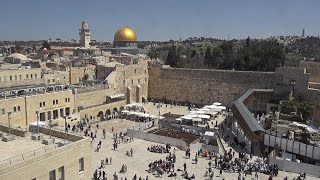
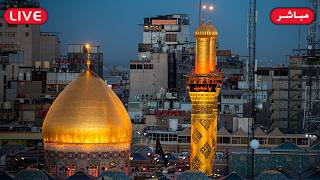
Dome of the Rock
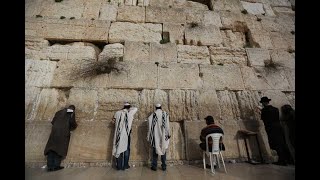
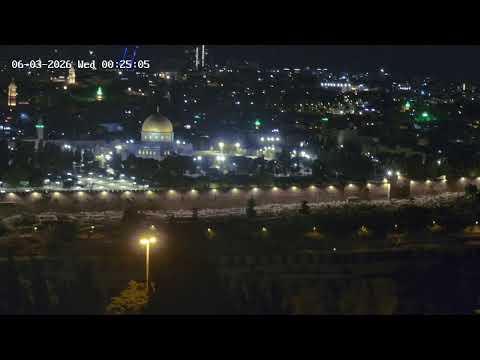
This live camera looks across the Old City of Jerusalem, focusing on the iconic Dome of the Rock and the surrounding Temple Mount complex. From this elevated view, the stream captures the dense historic architecture and the movement of people within one of the most significant religious sites in the world. The Temple Mount is one of the oldest continuously significant religious sites, sacred in Islam, Judaism and Christianity. Surrounding the area are key landmarks including the Western Wall and Al-Aqsa Mosque, all within the ancient walls of the Old City. This feed gives a direct view into a location shaped by thousands of years of history and ongoing cultural importance.
Jerusalem
- Aelia Capitolina
- ירושלים
- القدس
Jerusalem is a city situated in the Southern Levant on a plateau within the Judaean Mountains, positioned between the Mediterranean Sea and the Dead Sea. It holds significant administrative status as the claimed capital for both Israel and Palestine, though neither claim receives widespread international recognition. Israel maintains its primary governmental institutions there, including the Knesset, the Supreme Court, and the residences of the prime minister and president, while Palestine foresees it as its future seat of power. The city's political standing remains a core issue in the Israeli–Palestinian conflict, with its status historically debated under various international regimes.
The city possesses one of the oldest continuous histories in the world, with the earliest signs of settlement appearing in the City of David during the 4th millennium BCE. During the Canaanite period, it was known as Urusalim, and by the 9th century BCE, it had developed into the religious and administrative center of the Kingdom of Judah. Its long history includes being destroyed twice, besieged 23 times, and captured 44 times. The current city walls were rebuilt in 1538 under Suleiman the Magnificent, enclosing the Old City which was designated a World Heritage Site in 1981 and placed on the List of World Heritage in Danger.
The Old City covers an area of only 0.9 square kilometers and has been divided into four quarters since the 19th century: Armenian, Christian, Jewish, and Muslim. This compact area is home to seminal religious sites for Judaism, Christianity, and Islam, including the Western Wall, the Dome of the Rock, the Qibli Mosque, and the Church of the Holy Sepulchre. Surrounding the historic core are modern civic and cultural centers in western Jerusalem and Arab neighborhoods in the east. The city's landscape is defined by the juxtaposition of ancient neighborhoods against contemporary high-rise apartments and office towers.
As a holy city for three major Abrahamic religions, Jerusalem serves as a spiritual center for Judaism and Christianity and the third-holiest site in Islam. Its religious significance draws numerous visitors to its historic, archaeological, and cultural sites. The city offers vibrant shopping centers, cafes, and restaurants alongside its sacred landmarks. It is considered one of the main tourist destinations in Israel due to this unique blend of ancient heritage and modern urban life, where first-century history coexists with twenty-first-century infrastructure.
In 2024, Jerusalem had a population of 1,050,151 residents. Demographic data from 2022 indicates that 60% of the population were Jews and almost 40% were Palestinians. The city's economy is driven by its status as Israel's capital and its role as a major religious and cultural hub. While specific transport details are not enumerated, its accessibility is implied by its status as a primary destination for international tourism and pilgrimage, supported by its infrastructure as the seat of national government.
 The EARF Engine