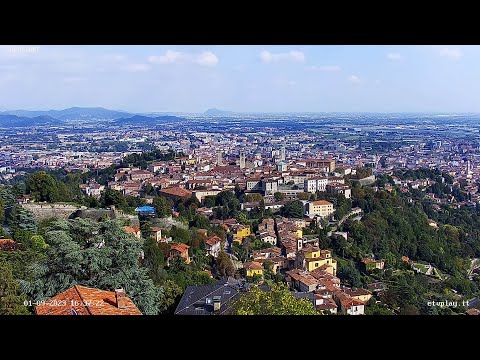


Bergamo, Italy
 IT
IT- Bergame
- Bèrghem
- Bergomum
Bergamo is a city in the Lombardy region of northern Italy, serving as the seat of the province of Bergamo. It sits approximately 40 kilometers northeast of Milan, near the beginning of the Bergamo Alps. The municipality encompasses both a historic hilltop core and modern plains, forming an integral part of the broader Milan metropolitan area.
First settled by the Ligurian Orobii and later conquered by Celts, Bergamo became a Roman municipality in 49 BCE as Bergomum. It served as a key Lombard duchy seat before becoming an independent commune in the 11th century. Venetian rule from 1428 led to extensive fortifications, with the upper town's defensive walls designated a UNESCO World Heritage Site in 2017.
The city is divided into the historic Città Alta and the modern Città Bassa, connected by funiculars and roads. Key landmarks include the Venetian walls, Piazza Vecchia, and the Basilica di Santa Maria Maggiore, which houses the tomb of composer Gaetano Donizetti. The Cappella Colleoni stands as a masterpiece of Renaissance architecture within the upper town.
Recognized for its artistic treasures and medieval atmosphere, Bergamo attracts visitors to its scenic beauty and industrial heritage. It gained fame as Città dei Mille due to its role in Giuseppe Garibaldi's expedition. The city also hosted the 2017 G7 summit on agriculture, producing the Charter of Bergamo to address global hunger and agricultural development.
Bergamo has a population of 119,534 as of 2023. It is one of Italy's most industrialized cities, supported by Il Caravaggio International Airport, which handled 12.3 million passengers in 2017. The city offers extensive transport links via the A4 motorway and serves as a major hub for low-fare airlines operating in the region.
 The EARF Engine