







Live stream unavailable
This camera is offline or temporarily unavailable. It may be under maintenance, having technical trouble, or it may have been removed by the provider. Listings are monitored continuously and this page updates when the stream returns.


Kyoto Station's Stairs
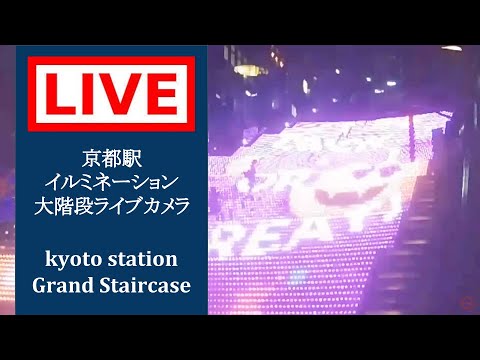
This live camera shows the iconic Grand Staircase inside Kyoto Station in Kyoto, Kyoto Prefecture, Japan — one of the most striking architectural features of the station’s vast modern interior. The broad multi‑level steps draw travelers and visitors alike, with a constant flow of people ascending and descending between concourses, shops, and upper viewpoints. By night the stairs come alive with thousands of changing LED lights in dazzling patterns and seasonal designs, creating a vibrant visual spectacle in the heart of this historic city’s busiest transport hub.
Kyoto, Japan
 JP
JP- Kyoto City
- Kyôto, Kyôto
- Kyoto-shi
Kyoto is the capital city of Kyoto Prefecture, situated in the Kansai region on Honshu, Japan's largest island. It serves as the cultural anchor for the Greater Kyoto metropolitan statistical area and forms part of the larger Keihanshin metropolitan area alongside Osaka and Kobe. The city lies within a valley in the Yamashiro Basin, surrounded by the mountainous Tamba highlands. As an administrative center, it hosts the national government's Agency for Cultural Affairs, which relocated there in 2023, reinforcing its status as a key hub for cultural administration.
Emperor Kanmu established the city in 794 as Heian-kyō, modeling its grid layout after the Chinese capitals of Chang'an and Luoyang. It served as Japan's imperial capital for over a millennium until the Meiji Restoration transferred the seat to Tokyo in 1869. The modern municipality was officially formed on April 1, 1889. Although it suffered extensive destruction during the Ōnin War of 1467–1477, Kyoto was largely spared from conventional bombing and atomic targeting during World War II, preserving its prewar cultural heritage.
The city is renowned for its abundance of traditional townhouses known as machiya and historic monuments inscribed as UNESCO World Heritage Sites in 1994. Prominent landmarks include the Kyoto Imperial Palace, Kiyomizu-dera, Kinkaku-ji, Ginkaku-ji, and Kyoto Tower. Public buildings from the late Meiji era incorporate European design elements, such as the French Second Empire style of the Kyoto National Museum. The urban core retains its original grid pattern, with west-east streets numbered sequentially.
Kyoto is considered the cultural capital of Japan, attracting visitors with its temples, shrines, palaces, and gardens accumulated over a thousand years as the imperial seat. It is home to Nintendo and Kyoto University, the second-oldest university in the country. The city offers a multi-lingual official travel guide and features districts rich in material heritage. Visitors often explore the hidden beauty of temples and parks that ring the city center, contrasting with the ultra-modern glass-and-steel train station.
As of 2022, the population was 1,448,964, making it the ninth-most populous city in Japan. The economy benefited from early industrial developments like the Lake Biwa Canal and Japan's first commercial electric railway in 1895. Kyoto experiences four distinct seasons, with humid summers and cold winters without snowfall. The rainy season runs from mid-June to late July, while typhoons occur in late August and September, influencing travel patterns.
 The EARF Engine






![[公式]スターキャット thumbnail](https://yt3.ggpht.com/HctH3nbthpSnqkSmip0mKd58sfF8jrSu-3nQQPGjNXZrZ6-M1aWifq38wUMqEBgM31B8Qz08=s800-c-k-c0x00ffffff-no-rj)