










Oustecké Station
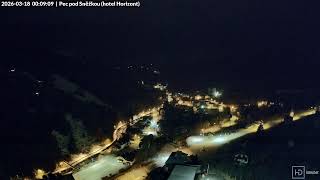
This live stream shows Oustecké Station in Ústí nad Orlicí, a historic railway hub in eastern Bohemia. The camera captures the station's preserved 19th-century architecture, including its stone façade and original platform layout. Serving as a junction for the Prague–Košice international line and the Ústí nad Orlicí–Międzylesie route to Poland, the station handles both passenger and freight traffic. With eight tracks and three island platforms, it supports high-volume operations and offers real-time views of train arrivals and departures.
Ústí nad Orlicí, Pardubice, Czech Republic
 CZ
CZ- Wildenschwert
Ústí nad Orlicí is a town situated in the Pardubice Region of the Czech Republic. It lies within the Svitavy Uplands, positioned at the confluence of the Tichá Orlice and Třebovka rivers. The settlement is located approximately 44 kilometres east of Pardubice, with its highest point being Strážný hill at 584 metres above sea level. As an urban municipality, it serves as a regional centre in eastern Bohemia.
The town was founded in the second half of the 13th century during the reign of King Ottokar II of Bohemia, evolving from a Slavic settlement called Oustí. Its first written mention dates to 1285, when King Wenceslaus II gifted it to Záviš of Falkenstein. Subsequent ownership passed to Cistercian monks and various noble families before the Liechtenstein family acquired it after 1620. The historic town centre is well preserved and protected as an urban monument zone.
The character of the town is defined by its regular rectangular Mírové náměstí square, which retains its original floor plan and is surrounded by valuable arcaded houses. Key landmarks include a Marian column from 1737, the Baroque town hall built between 1721 and 1723, and the late Baroque Church of the Assumption of the Virgin Mary constructed in the 1770s. Other notable sites include the wooden Church of the Visitation of Our Lady in Horní Houžovec and the Church of Saints Peter and Paul in Knapovec.
Historically, Ústí nad Orlicí gained the tagline The Manchester of Eastern Bohemia due to its booming textile business following its connection to the railway network in 1845. This industrial heritage established it as an important textile centre and railway junction. While specific modern festivals are not detailed, the town's appeal lies in its preserved architecture and its role as a cultural hub that developed from guilds of weavers established in the 16th century.
The population is recorded at 14,011 as of 2025. The largest industrial employer is Rieter CZ, a manufacturer of textile machinery with more than 250 employees. Transport infrastructure includes the I/14 road and several railway lines, such as the Prague–Košice international line and regional routes to Litomyšl. The town is twinned with cities in Germany, Poland, Italy, Slovakia, and Berlin.
 The EARF Engine