







Savona Rail Cam
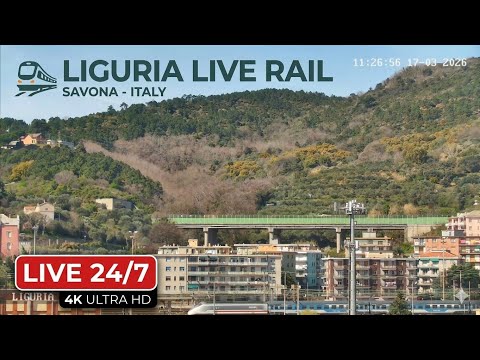
This live webcam provides a sharp, real-time view over the coastal rail corridor in Savona, a key transport point along the scenic Ligurian Riviera. From this vantage, you can watch a steady mix of regional passenger services and freight traffic moving along the vital Genoa–Ventimiglia railway, a line known for hugging the Mediterranean shoreline and linking major coastal towns. Dominating the upper view is the “Rio Cadeina” viaduct, part of the Autostrada A10. Often referred to as the Autostrada dei Fiori, this elevated motorway forms a crucial route between Italy and France, frequently running parallel to the railway and highlighting the layered infrastructure of the region. Set within Liguria, Savona serves as an important logistical and transport hub, where rail and road networks intersect to support both local mobility and long-distance travel across northwestern Italy. The scene captures a dynamic slice of everyday movement, framed by coastal geography and essential infrastructure.
Savona, Italy
 IT
IT- Sann-a
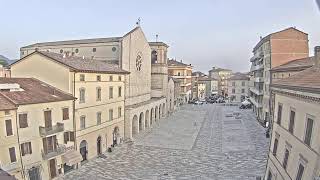
Savona is a coastal city and comune in the Liguria region of northern Italy, serving as the capital of the Province of Savona. Situated on the western Italian Riviera between the Ligurian Sea and the Ligurian Alps, it functions as a seaport and the main city of the region's western section. The town lies approximately 40 kilometres west of Genoa and about 150 kilometres east of Nice in France, establishing its position within the broader geographical context of Northwest Italy.
Inhabited by Ligures tribes in ancient times, Savona came under Roman influence around 180 BC after the Punic Wars. Following the fall of the Western Roman Empire, it experienced Lombard, Ostrogoth, and Byzantine rule before becoming a county seat in the Carolingian Empire. The city gained independence in the 11th century as a free commune allied with the Holy Roman Emperor, later fighting Genoa before being conquered in 1528. It subsequently shared Genoa's fortunes until annexed to the Kingdom of Sardinia-Piedmont in 1815 and eventually unified Italy.
The historic centre features significant landmarks including the Priamar fortress, built by the Genoese in 1542, and the Torre Leon Pancaldo, a 14th-century symbol of the town. The Cattedrale dell'Assunta, constructed after the Genoese demolition of the old cathedral, houses relics of Saint Valentine and ornate wooden choir stalls. Nearby stands the Cappella Sistina, containing the Mausoleum of Pope Sixtus IV, while the Palazzo Della Rovere and Palazzo Gavotti represent important architectural heritage from the Renaissance and later periods.
Savona offers cultural attractions such as the Art Museum of Palazzo Gavotti and the Museum Centre of Priamar. The city hosts annual events including the Carnival with its Cicciulin costume, the Patron saint's festival on 18 March, and a Holy Friday procession every two years. Notable residents include navigator Christopher Columbus, who farmed land in the area, and Pope Julius II. The local sports scene features Rari Nantes Savona, a professional water polo team, and Savona FBC, the regional football club.
As of 2023, the population is 58,194, though other sources cite 58,690 in 2025. The city serves as a regional industrial hub with a Mediterranean climate characterized by hot summers and mild winters. Accessible by car via the A10 highway or by frequent Trenitalia trains from Genoa, Savona provides easy connectivity to surrounding areas. Visitors can explore the compact historic centre on foot or use local bus services to reach the beach, benefiting from over 2,097 hours of sunshine annually.
 The EARF Engine











![[公式]スターキャット thumbnail](https://yt3.ggpht.com/HctH3nbthpSnqkSmip0mKd58sfF8jrSu-3nQQPGjNXZrZ6-M1aWifq38wUMqEBgM31B8Qz08=s800-c-k-c0x00ffffff-no-rj)