






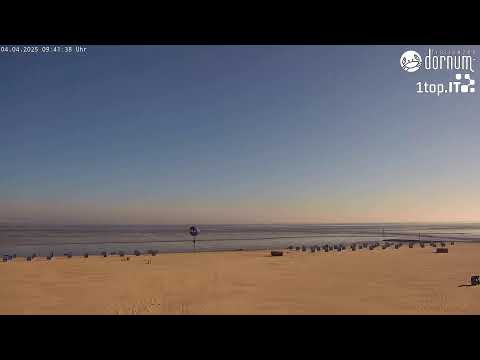


Dornumersiel Beach
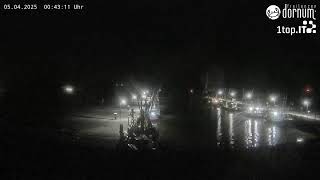
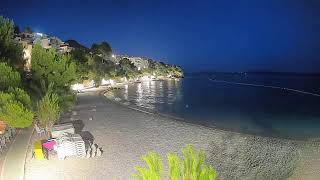
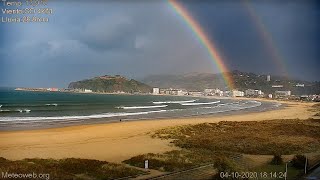
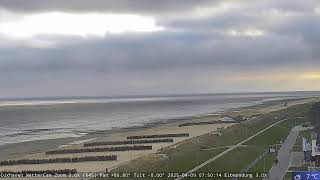
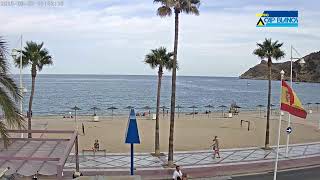
This live webcam shines on the beach at Dornumersiel in the municipality of Dornum, Lower Saxony, Germany. You’ll see a broad stretch of sandy shoreline along the North Sea coast, dotted with traditional German beach chairs (“Strandkörbe”), beside flat tidal zones of the Wadden Sea.
Dornum, Lower Saxony, Germany
 DE
DEDornum is a village and municipality situated within the East Frisian district of Aurich in Lower Saxony, Germany. It lies near the North Sea coast, positioned approximately fifteen kilometers east of Norden and twenty kilometers north of Aurich. This location places it firmly in the northwest part of the country, serving as an administrative center for its surrounding rural area while maintaining close ties to the coastal geography of East Frisia.
The municipality possesses a significant historical legacy, particularly regarding its Jewish community during the Nazi era. On November 7, 1938, the local synagogue was deconsecrated and sold for six hundred Reichsmarks to August Tessmer, who converted it into a storeroom. Despite this sale, Kristallnacht saw the building's windows smashed and furnishings burned on the market square. Sturmabteilung troops arrested Jewish residents that night, deporting men to Sachsenhausen concentration camp while releasing women and children days later.
Dornum is divided into ten distinct districts, including Dornumergrode, Neßmersiel, and Westerbur, which contribute to its varied local character. The area features several notable landmarks such as the Lutheran St. Bartholomaeus Church, which houses an organ by Gerhard von Holy considered a national treasure. Other key sites include Water Castle Norderburg, Grandma Freese Huus, and the only surviving synagogue building in East Frisia, preserving the memory of its former community.
Visitors are drawn to Dornum for its cultural heritage and natural surroundings, including the Nationalpark-Haus Dornumersiel and the Zwei-Siele-Museum. The town offers dining options like Restaurant Fährhaus and Restaurant Käthe & Karl, catering to tourists exploring the region. The presence of historical sites related to the Marx Brothers, whose mother Miene Schönberg was born there in 1865, adds a unique biographical layer to the local tourism appeal.
As of 2024, Dornum has a population of 4,351 residents. The economy is notably influenced by energy infrastructure, hosting the receiving terminal for gas through Europipe I and II. This facility transports gas via a forty-eight-kilometer pipeline to Emden for metering before routing it to customers in Germany, the Czech Republic, and Austria, making it a critical node in regional energy distribution networks.
 The EARF Engine